












Since the launch of ChatGPT, AI has firmly established itself as a key player across nearly every aspect of marketing and technology—from strategy development to content creation. Today, most marketing platforms feature AI-driven tools, and AI has become seamlessly integrated into our everyday processes.
Naturally, search engines have followed suit.
In May 2023 Google introduced the Search Generative Experience (SGE), an AI-powered search feature currently in beta through Search Labs. This initiative represents a major shift in how search results are generated and displayed, with significant implications for SEO.
For the first time, Google’s search engine results page (SERP) is not just curating and organizing existing content; it is creating new content based on the information retrieved. This AI-driven approach allows users to receive immediate, concise answers to their queries, reducing the need to click through individual websites.
In this comprehensive guide, we’ll dive into everything you need to know about Google’s SGE and its potential impact on SEO both in Australia and globally.
What Is Google SGE and AI Overviews?
Google’s Search Generative Experience (SGE) enhances the search process by incorporating advanced AI algorithms to provide more efficient and relevant results.
Utilizing large language models (LLMs) such as the Multitask Unified Model (MUM) and Pathways Language Model 2 (PaLM2), SGE offers rich, contextual answers directly within the search results. This feature is designed to make web information discovery faster, more intuitive, and far more comprehensive than traditional search methods.
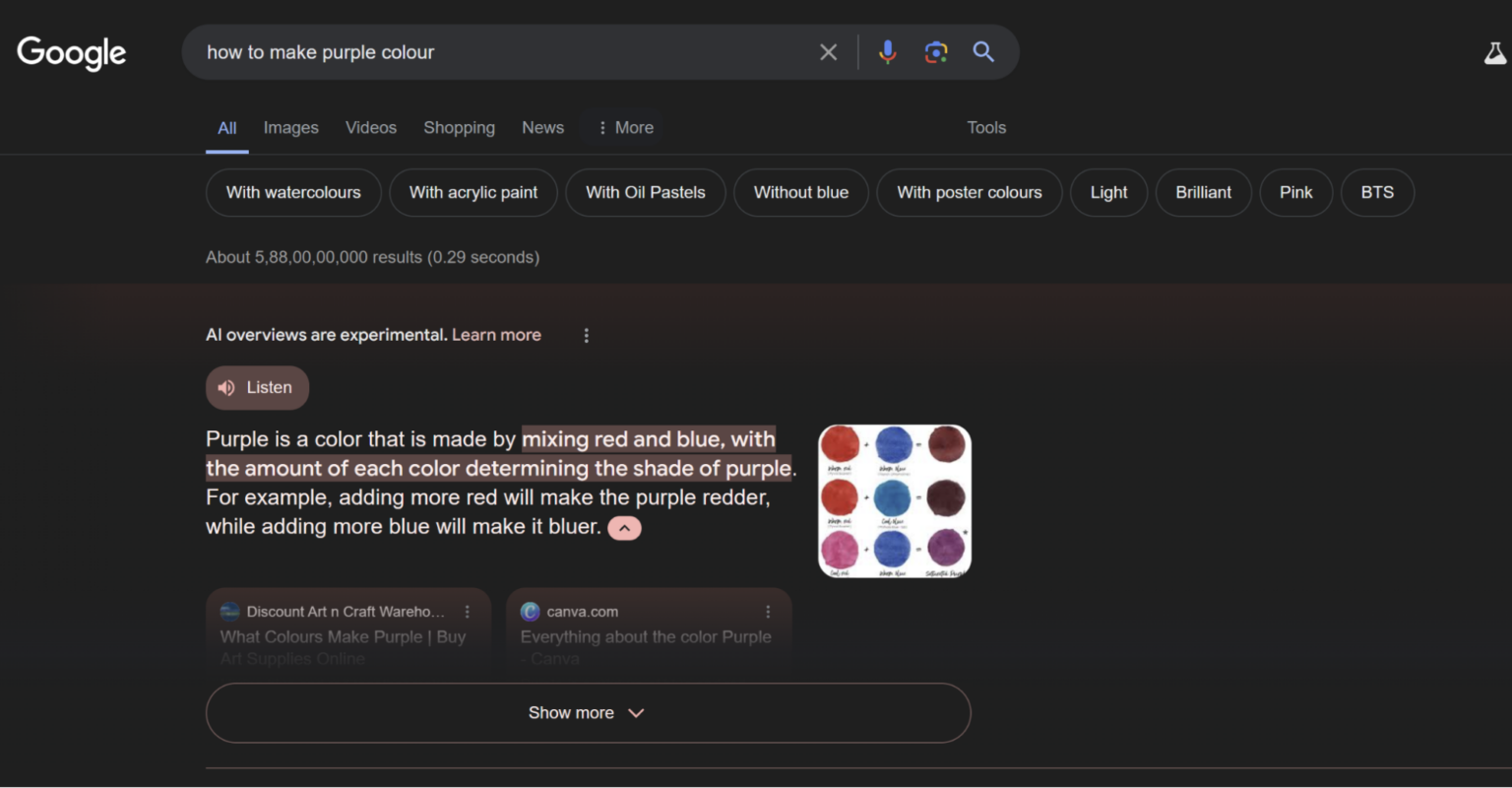
Currently in its experimental phase, SGE can assist in various ways, such as:
- Providing quick answers and step-by-step instructions
- Offering concise topic overviews
- Summarizing key takeaways
For example, if you’re searching for how to create purple paint, pre-SGE Google would direct you to multiple websites offering how-to articles and videos from platforms like YouTube. With SGE, the top result will feature an AI-generated response, drawn from multiple sources, giving you an immediate answer. Below that, the usual search results will still be available, with an option to “Show more” for a deeper, source-cited explanation. You can also ask follow-up questions and rate the answer with thumbs up or down.

The Technology Behind Google SGE / AI Overviews
Google’s Search Generative Experience (SGE) relies on a combination of its proprietary technologies, including BERT (Bidirectional Encoder Representations from Transformers) and newer models like MUM (Multitask Unified Model) and PaLM (Pathways Language Model). These cutting-edge models allow the system to better understand and generate human-like responses to intricate queries.
Here’s an overview of how the process works:
- Query Understanding: SGE first interprets the user’s query using natural language processing (NLP), helping the system understand the intent and nuances of the request.
- Information Retrieval: Next, it retrieves relevant information from a vast database of web pages, ensuring a comprehensive selection of data is taken into account.
- Content Generation: Using generative AI, SGE combines the gathered information to craft a clear, contextually relevant response, which appears at the top of search results along with cited sources.
- Response Refinement: The system also allows for follow-up questions, transforming the search into a more interactive conversation for a deeper exploration of the topic.
How to Access Google SGE / AI Overviews
Currently in experimental mode, Google SGE is available in [countries/regions] (but not yet in Australia) and supports seven languages. To access it, you need to opt-in.
Here’s how you can enable Google SGE:
- Open Google Chrome or the Google app on your device.
- Go to ‘Settings’ and select ‘Labs’ or ‘Experiments’ (the name may vary depending on your region).
- Find the option labeled ‘Search Generative Experience’ and toggle it on.
- Accept any terms of service if prompted, and you’re ready to start using the enhanced search feature.
As of the latest updates, Google SGE is expanding gradually worldwide. While there’s no official launch date for Australia yet, the rollout in other regions suggests it could be available soon as part of a phased global launch. Stay tuned to Google’s official announcements for the most up-to-date information on its availability.
The Key Advantages of Google’s Generative AI in Search
By now, you’re likely familiar with generative AI tools like ChatGPT or Midjourney. Google’s Search Generative Experience (SGE) taps into the same powerful generative AI technology to revolutionize how users engage with search engines.
Here are the core benefits of incorporating generative AI into search:
A Simplified Approach to Complex Topics
Generative AI excels in simplifying intricate topics into clear, concise summaries. SGE leverages deep learning algorithms to analyze vast data sets, allowing it to comprehend complex subjects and present well-rounded overviews. This feature is invaluable for education, research, or anyone looking for a quick understanding of a complicated issue.
- Contextual Understanding: By using models like MUM, SGE connects various concepts across languages and formats, offering users a more complete perspective without needing to run multiple searches.
- Integrated Knowledge: It compiles information from diverse sources into a single, unified response, showcasing the most relevant facts and viewpoints.
More Engaging Search Results
SGE aims to enhance the search experience by delivering responses that are not just informative but also interactive.
- Dynamic Interaction: Users can ask follow-up questions directly in the search results, prompting the AI to provide deeper insights without needing additional searches.
- Personalized Experience: Over time, SGE learns from user behaviors and preferences, tailoring its responses to align with individual interests and past interactions.
Faster and More Direct Access to Information
One of SGE’s standout features is how quickly and directly it delivers information.
- Speed: Generative AI processes and summarizes vast amounts of data in real-time, drastically cutting down the time users spend searching for reliable answers.
- Direct Answers: Instead of offering a list of links, SGE displays direct answers at the top of the search results page, eliminating the need to visit multiple external sites.
- Efficiency: By reducing unnecessary searches and interactions with irrelevant content, SGE streamlines the search process, making it faster and more efficient.
AI Overviews / Google SGE: The Future of AI-Driven Search
With its advanced AI capabilities, Google’s SGE is poised to reshape the search experience by delivering faster, more accurate, and contextually relevant information. This initiative not only enhances user engagement but also improves access to knowledge, enabling users to make decisions more quickly and confidently.
As SGE evolves, Google’s goal is to integrate even more AI innovations that will further enhance the capabilities of the SERP, ensuring its continued dominance as the world’s leading search engine.
Google’s Generative AI and Brand Interaction
Through generative AI, Google is changing how brands interact with users and build trust:
- Better Content Discovery: AI-generated summaries can boost the visibility of authoritative brands, increasing the chances their content will appear prominently in search results.
- Improved Semantic Search: SGE can better understand the meaning behind content, improving how user queries match with brand content and increasing the likelihood of engagement.
- Cross-Referencing Data: SGE employs cross-verification techniques, pulling data from multiple sources to improve accuracy and reliability.
- Intent Recognition: By analyzing the context of queries, SGE can better gauge user intent, ensuring responses are more relevant and trustworthy.
- Sentiment Analysis: SGE integrates sentiment analysis to better capture the emotional tone of queries, helping refine the answers it delivers.
- Conversational AI: It facilitates a back-and-forth conversation between users and the search engine, mimicking human-like interactions that drive deeper engagement.
- Dynamic Content Presentation: Unlike static search results, SGE can create dynamic content, such as instant answers, side-by-side comparisons, and interactive elements, to engage users on a deeper level.
How Does Google SGE Compare to ChatGPT?
Since its launch in November 2022, ChatGPT has become a household name.
Though both Google SGE and ChatGPT utilize advanced AI and large language models, they serve different purposes and work in distinct ways.
- ChatGPT is primarily a virtual assistant designed to assist with brainstorming and a wide range of tasks, including more complex queries. It doesn’t pull real-time information from the web and answers based on its training data.
- Google SGE, on the other hand, is tailored for quickly finding specific information from content that’s published online, making it ideal for rapid, real-time searches.

Google AI Overviews vs. Bing
In the search engine space, Microsoft’s Bing was the first to integrate generative AI into its results to directly answer user queries.
As shown in the screenshot below, Bing AI and Google SGE share many similarities. Both encourage follow-up questions and provide concise snippets of information.
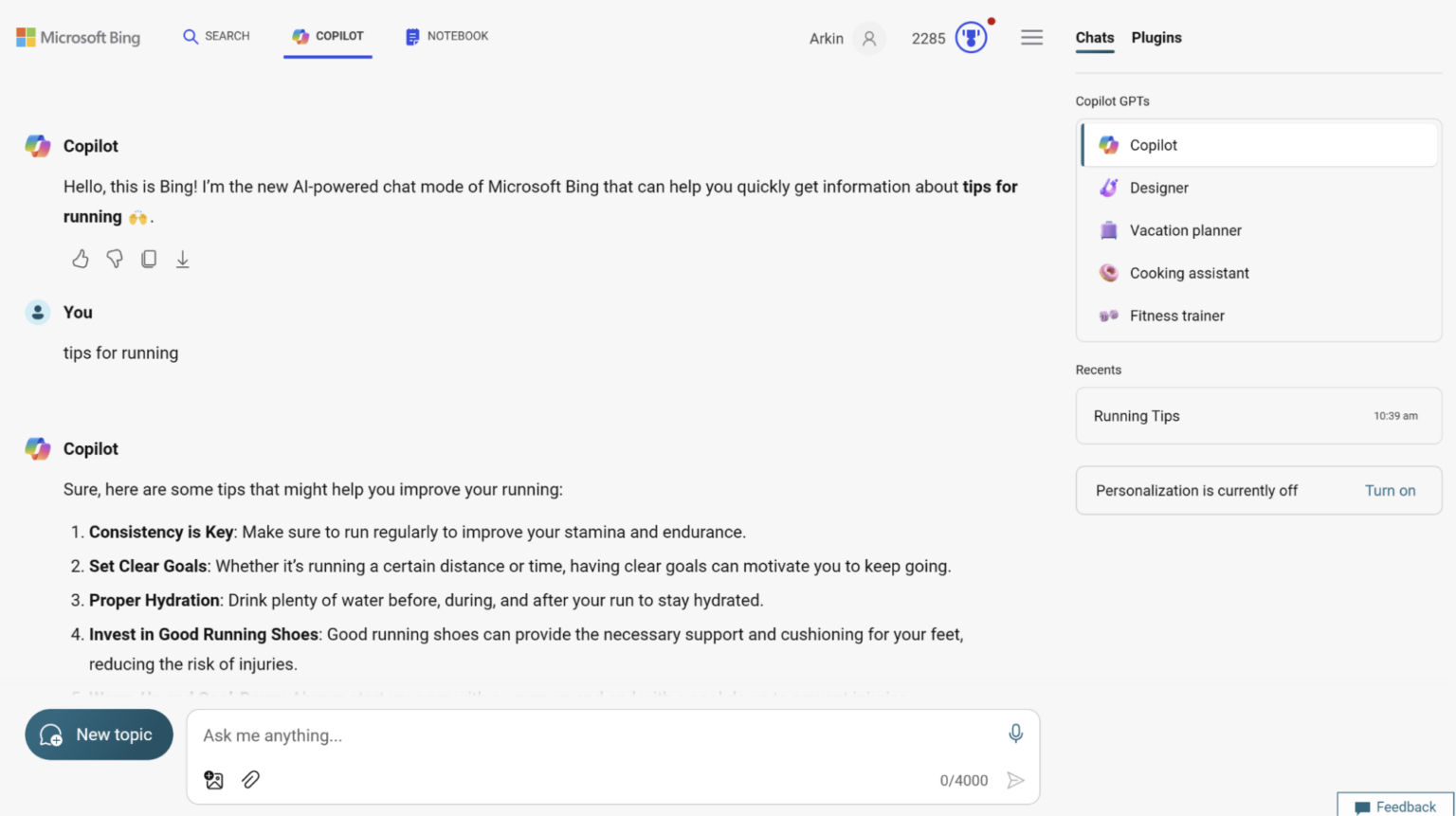
Bing also offers a “Copilot” mode, allowing users to engage in full conversations with the AI, much like ChatGPT.
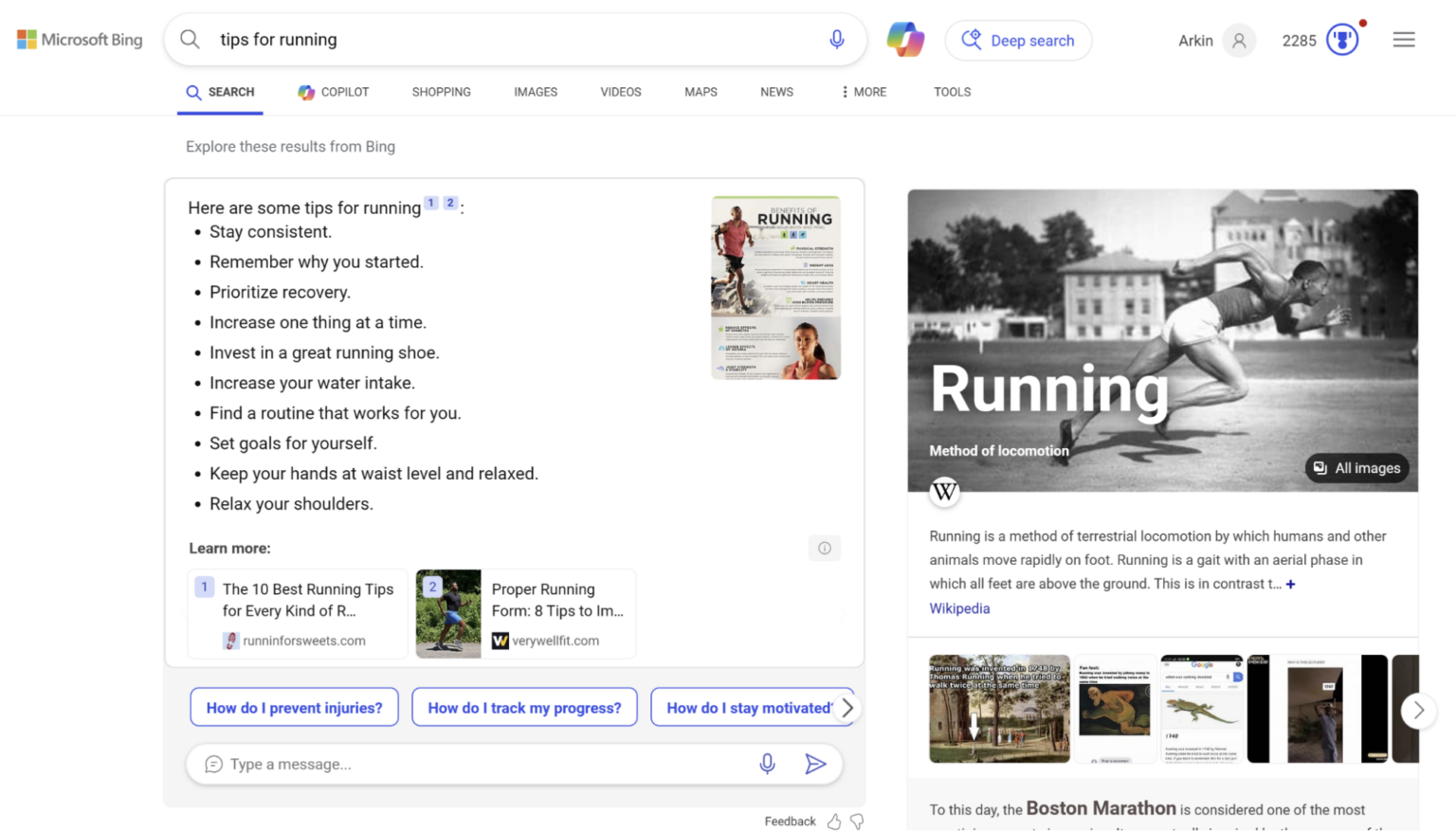
While both platforms are highly capable of delivering relevant results, Bing has the advantage of being available to all users worldwide, giving it a broader reach (no pun intended!).
Google AI Overviews vs. Perplexity AI
Perplexity AI is designed to compete with traditional search engines by using AI to provide accurate and reliable answers, all backed by citations. It’s especially useful for in-depth research on specific topics.

The platform prioritizes transparency by displaying the sources and reasoning behind the AI’s responses. Perplexity’s chat-based interface is streamlined and ideal for users seeking a deeper understanding of complex subjects, in contrast to Google SGE, which focuses more on delivering quick overviews and actionable insights.
Navigating the Challenges and Ethical Considerations of AI in Search
The introduction of AI technologies into search, particularly Google’s Search Generative Experience (SGE), presents several challenges that require thoughtful examination. Let’s explore some of these issues.
Geographic Limitations and Accessibility
A major hurdle for SGE and similar AI-driven search tools is their uneven global availability. While some regions with advanced internet infrastructure see rapid progress, areas with limited access to the internet or restrictive regulations may miss out on these innovations. This divide can deepen the digital gap, meaning not everyone benefits from AI’s advancements in search.
Balancing Accuracy with AI Creativity
AI models, including those used in SGE, strive to balance the need for factual accuracy with the creative generation of engaging content. The key challenge is ensuring that AI’s creative responses do not compromise the reliability of the information provided.
This is especially critical for topics that impact personal well-being, such as finance and health. Incorrect or misleading information could lead to safety risks, making it crucial for Google to prevent errors.
Common issues include AI “hallucination,” where the system generates incorrect facts, and AI bias, where the training data influences the neutrality of answers. To maintain accuracy, methods like cross-referencing large data sets and using verified information for training are essential.
Ensuring Content Visibility in an AI-Dominated Landscape
As AI takes on a larger role in curating and summarizing content directly within search results, questions arise about the visibility of original content creators. Brands and content producers now face the challenge of optimizing their SEO strategies to remain visible and relevant amidst this AI-driven search environment. To succeed, content must align with AI’s criteria for selection, such as relevance, authority, and engagement metrics.
This shift could also impact paid search visibility, a significant revenue stream for many businesses. It’s vital that SGE doesn’t reduce the visibility of paid ads, as this could harm brands relying on them for traffic.
Transparency and User Trust
As AI becomes an integral part of search, transparency is crucial to maintaining user trust. Users have reported varied experiences with the speed and relevance of AI-generated responses compared to traditional search results.
Google’s PaLM 2 model is closed-source, meaning its decision-making process is not disclosed. This lack of transparency could make users wary of how AI generates results. To maintain trust, it’s essential for SGE to provide users with clear explanations about how AI responses are formulated, including the sources and methods involved. Open channels for user feedback are key to addressing concerns over bias, privacy, and data security.
Key Challenges with Google SGE
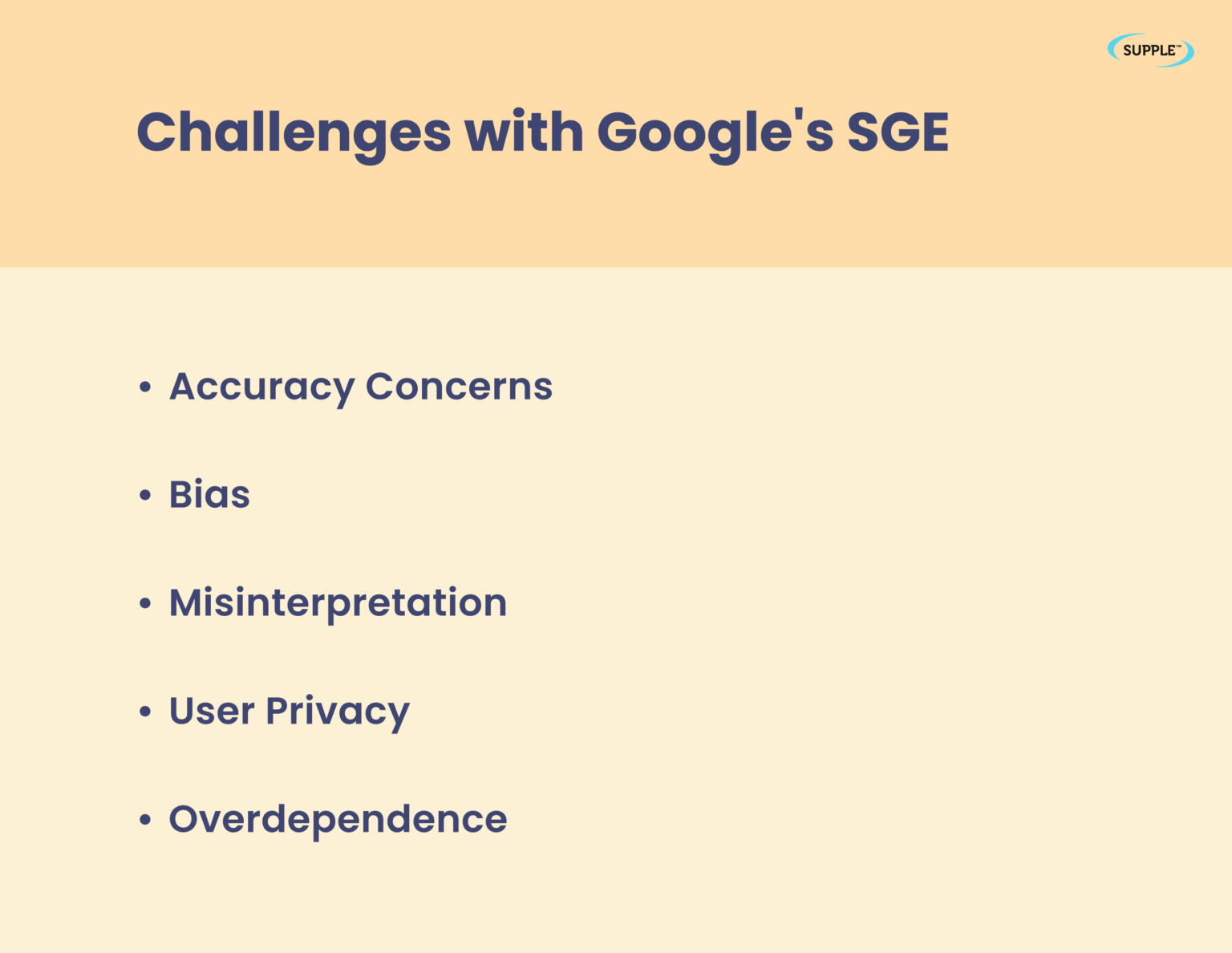
Here’s a quick overview of the primary challenges with Google’s SGE:
- Accuracy: AI-generated content may suffer from “hallucination,” leading to incorrect or biased information.
- Bias: The AI’s responses may reflect the biases in its training data, affecting the neutrality of answers.
- Misinterpretation: The AI may misinterpret subtle or nuanced language, leading to incorrect answers.
- User Privacy: The integration of AI in search raises concerns about how user data is collected and used.
- Overdependence: The efficiency of AI-driven answers may reduce the incentive for users to explore multiple perspectives or sources.
Addressing these challenges will be critical in ensuring that SGE delivers its promised benefits without compromising ethical standards or user trust.
The Future of SEO in an AI-First World
As SGE continues to roll out globally, the SEO landscape is on the verge of significant changes. For search marketers and brands, adapting to these changes will be essential.
Preparing for Shifts in SEO with AI-Powered Search
As we’ve seen, generative AI has a profound impact on SEO, and organic traffic is expected to decrease overall. Here’s a look at the effects:
- Impact on Visibility: SGE has pushed top organic search results lower on the page, reducing their prominence.
- Variety of Sources: About 62% of the links displayed by SGE come from websites outside the top 10 organic search results, creating new competition from a wider range of sources.
- Strategic Content: Research suggests focusing on producing comprehensive, multimedia-rich content to increase visibility in SGE results.
- Brand and Local Search: SGE might display competitor links in searches related to specific brands, potentially diluting brand authority.
While SGE lowers organic traffic, it might result in more qualified visitors who are likely to convert. Users may still click through to cited sources for deeper research, often with higher intent to engage.
Key Areas for SEO and Content Marketers to Focus On
- Long-Tail Keywords: As SGE values detailed queries over short phrases, marketers should optimize for long-tail keywords. For example, targeting phrases like “comfortable walking shoes for daily use” will make content more specific and relevant.
- Crafting Quality Content: Quality remains a priority for SGE. Create authoritative content backed by credible sources and expert opinions. Understand the user’s search intent to deliver content that satisfies their needs, whether it’s informational, navigational, commercial, or transactional.
- Natural Language Optimization: SGE better understands everyday language, so ensure content mirrors the way your audience speaks. This is especially important for voice searches, where conversational language is key.
Google’s Forward-Looking Vision with SGE
Looking ahead, the evolution of Google SGE is closely tied to advancements in AI, with projects like DeepMind and Gemini shaping its future. These innovations will continue to improve SGE’s ability to understand complex queries and provide more precise, contextually aware answers.
The Next Frontier: Local Packs and Personalization
SGE is also working to optimize local search results. Local business profiles, such as Google Business Profiles, will be a key source for local packs that include maps and region-specific information. This feature is particularly valuable in sectors like restaurants and travel, where local relevance is crucial.
For businesses looking to win local search results:
- Manage Reviews Actively: Engage with reviews regularly to boost visibility.
- Optimize Local Listings: Tailor your local listings to cater specifically to location-based searches.
- Monitor SGE’s Local Modules: Stay updated on how SGE displays local search results to refine your SEO strategy.
Addressing Copyright and Organic Traffic Concerns
As AI becomes more prominent on the SERP, Google faces the challenge of balancing AI-generated results with fair attribution to content creators. Maintaining a healthy content ecosystem while ensuring original sources are acknowledged and rewarded is crucial.
Google SGE’s Impact on Australian Businesses
As SGE slowly rolls out worldwide, Australian businesses should prepare for its eventual arrival. While SGE isn’t yet available in Australia, its impact is expected to be significant. Here are some frequently asked questions:
- Will Australian businesses be impacted by Google SGE?
Yes, Australian businesses will need to adapt their SEO and content strategies to ensure they remain visible in this AI-first search environment. - How can Australian businesses prepare?
Focus on enhancing content quality, implementing structured data, and optimizing for voice search to align with SGE’s capabilities. - Which industries will be most impacted?
Industries like retail, hospitality, and professional services, which rely on search-driven customer acquisition, will feel the impact most.
Key Takeaways for Australian Businesses:
- Track Key Metrics: Monitor organic search traffic, click-through rates, bounce rates, and conversion rates to understand SGE’s effect.
- Optimize for Local Search: As SGE will prioritize localized content, optimizing local listings and reviews is crucial.
Conclusion: SGE’s Long-Term Impact on the Future of Search
Google SGE is a game-changer for search engines, providing faster, more personalized results. Australian businesses must adapt their SEO strategies to focus on high-quality, structured content that aligns with SGE’s evolving capabilities to stay relevant in this new search era.