











Key Takeaways
- ChatGPT and Perplexity are advanced AI search tools that generate answers and summaries directly from websites, transforming how businesses gain visibility online.
- Optimising for ChatGPT and Perplexity ensures your content is referenced in AI-generated responses.
- Key strategies include structured content, clarity, authority, and answerability to improve your chances of being cited.
- Long-tail queries are increasingly important in AI search, so businesses should focus on addressing niche, specific questions.
- By optimising for AI search, Australian businesses can attract more qualified traffic and strengthen brand trust.
Introduction
Are you ready for the next evolution in search? With AI tools like ChatGPT and Perplexity becoming the primary way many users seek information, optimising your content for AI citation is now more important than ever. This guide explains how to optimise content for ChatGPT and Perplexity, focusing on long-tail queries and actionable content structures to ensure your business gets noticed by AI search engines.
Table of Contents
- What Is ChatGPT and Perplexity?
- Why Optimise for ChatGPT and Perplexity?
- How ChatGPT and Perplexity Work
- Best Practices for Optimising Content for AI Search Engines
- Tools and Resources for AI Optimisation
- Industry Trends Influencing AI Search
- Final Thoughts
- FAQs
What Is ChatGPT and Perplexity?
ChatGPT and Perplexity are cutting-edge AI search tools that are transforming the way users find information. Instead of just directing users to websites, these platforms generate answers directly in search results, providing fast and useful information.
ChatGPT
Developed by OpenAI, ChatGPT generates human-like text responses. It analyses user queries and produces detailed answers by referencing a variety of sources. It’s particularly effective for queries requiring explanations, advice, or summaries, making it a powerful AI search tool.
Perplexity
Perplexity functions similarly but focuses on generating concise summaries from multiple sources. Its goal is to provide thorough, contextually accurate answers, especially for complex questions.
Both platforms rely on Generative AI, offering a conversational and helpful alternative to traditional search engines.
Why Optimise for ChatGPT and Perplexity?

Optimising for AI search tools is becoming essential as more people rely on them for answers. Here’s why:
- AI Search Is Becoming the Default
Users increasingly prefer direct answers from AI over traditional search results. By optimising for ChatGPT and Perplexity, your business can appear in AI-generated summaries, maintaining visibility in this evolving search landscape. - Targeting Long-Tail Queries
AI excels at answering specific, niche questions, often converting better than high-volume generic searches. Optimising for these queries can attract qualified traffic. For example, answering, “How do I start a small business in Melbourne?” can help your business appear in targeted AI responses. - Higher Visibility and Traffic Quality
Being cited by AI tools increases visibility to users seeking trusted answers. AI-driven search often references authoritative sources, resulting in higher-quality traffic and better engagement. - Building Trust and Authority
AI citations position your brand as a trusted authority. Platforms like ChatGPT and Perplexity reward high-quality, expert content, strengthening your credibility and supporting long-term growth.
How ChatGPT and Perplexity Work
Understanding how these AI tools generate answers is key to effective optimisation:
- Input Processing
The AI interprets the user query, considering context and intent. - Data Collection
ChatGPT draws on books, websites, and articles, while Perplexity aggregates information from multiple trusted sources to create concise summaries. - Answer Generation
The systems produce a clear, human-readable answer tailored to the user’s question. - Output Delivery
The generated response is presented at the top of search results, often as a direct summary, making it critical for businesses seeking AI visibility.
Best Practices for Optimising Content for ChatGPT and Perplexity
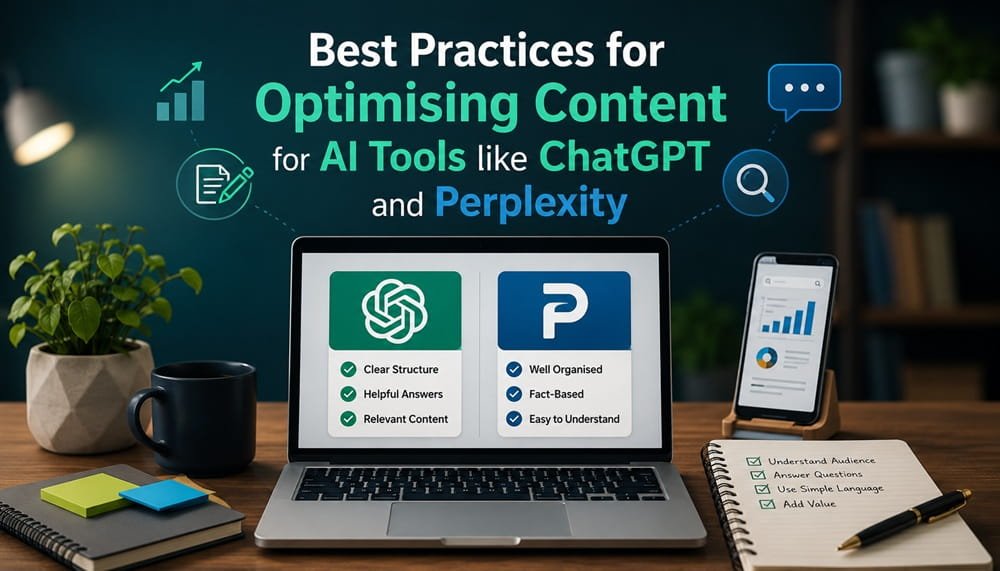
- Create Clear, Structured Content
Use headings, bullet points, and numbered lists. Ensure questions are answered at the start of each section. - Focus on Long-Tail Keywords and User Intent
Target specific queries that AI systems excel at answering. - Answer Directly
Provide concise, direct answers first, followed by detailed explanations. - Implement Schema Markup
Use FAQ or How-To schema to help AI understand and cite your content. - Regularly Update Content
Fresh content increases the likelihood of AI citation. Update statistics and ensure information stays relevant.
Tools and Resources for AI Optimisation
- Google Search Console – Monitor performance and identify queries triggering AI impressions.
- SEMrush and Ahrefs – Conduct content gap analysis to find AI-friendly long-tail queries.
- Schema Markup Generator – Tools like Merkle’s Schema Generator simplify adding structured data.
Industry Trends Influencing AI Search
- Voice Search and Conversational Queries – Optimise for natural-language, spoken queries.
- Shift Towards Direct Answers – Focus on delivering precise answers to user questions.
- Content Authority and Expertise – AI rewards authoritative, high-quality content.
Final Thoughts
AI-driven search tools like ChatGPT and Perplexity are changing the digital landscape. Businesses must optimise their content for AI citation to maintain visibility and capture qualified traffic. By focusing on long-tail queries, content structure, and authoritative content, your website can remain a trusted source for AI search tools.
At DigiTotal, we specialise in AI-driven SEO strategies to help your business optimise for both traditional search engines and AI tools like ChatGPT and Perplexity. Our team can ensure your content stays visible in AI-powered search results and ahead of the competition.
FAQs
What is ChatGPT, and how does it work for SEO?
ChatGPT is an AI language model from OpenAI that processes and generates human-like text based on queries. It produces relevant answers directly in search results, making it vital for AI-powered SEO.
What is Perplexity, and why should I optimise for it?
Perplexity summarises multiple sources to provide concise answers in search results. Optimising for it ensures your content is structured for AI extraction, making your website a trusted source.
How do I optimise for ChatGPT and Perplexity?
- Target long-tail queries
- Structure content with headings, bullet points, and numbered lists
- Provide clear, direct answers
- Implement schema markup
- Publish authoritative and helpful content
How long does it take to see results from AI optimisation
Results vary but typically appear within 3–6 months, depending on content quality, competition, and indexing speed.
Can I optimise for both traditional SEO and AI search?
Yes. Combining both strategies ensures visibility across search engines and AI platforms, driving high-quality traffic.
How can I measure the success of AI optimisation?
Use tools like Google Search Console to monitor AI-driven impressions and track whether your content appears in AI-generated answers.