
Key Takeaways
- AI SEO leverages automation and predictive modeling, while traditional SEO relies on manual tasks.
- AI-driven SEO enhances speed, scalability, and accuracy of decisions.
- Generative AI SEO improves content structuring and intent alignment.
- AI SEO offers cost-effective growth opportunities, especially for small businesses.
- While traditional SEO remains foundational, integrating AI is now essential.
- In 2026, businesses using AI-driven SEO are outperforming those sticking to outdated methods.
Still Using Traditional SEO?
The SEO landscape has evolved significantly in recent years. While many businesses in Australia continue to rely on traditional SEO techniques, others are adopting AI-powered SEO to stay ahead of the competition. So, what exactly is different in 2026?
This article breaks down the key distinctions between traditional SEO and AI-driven SEO. Whether you’re a small business owner or a marketing manager, understanding these changes will help you grasp how search engine optimization has transformed.
Table of Contents
- What is Traditional SEO?
- What is AI SEO?
- AI SEO vs Traditional SEO: A Side-by-Side Comparison
- Why This Difference Matters for Australian Businesses
- How AI-Powered SEO Works
- Tools & Resources to Strengthen Your Strategy
- Industry Trends Shaping SEO in 2026
- AI SEO vs Traditional SEO in 2026 — Which One Wins?
- FAQs
What is Traditional SEO?
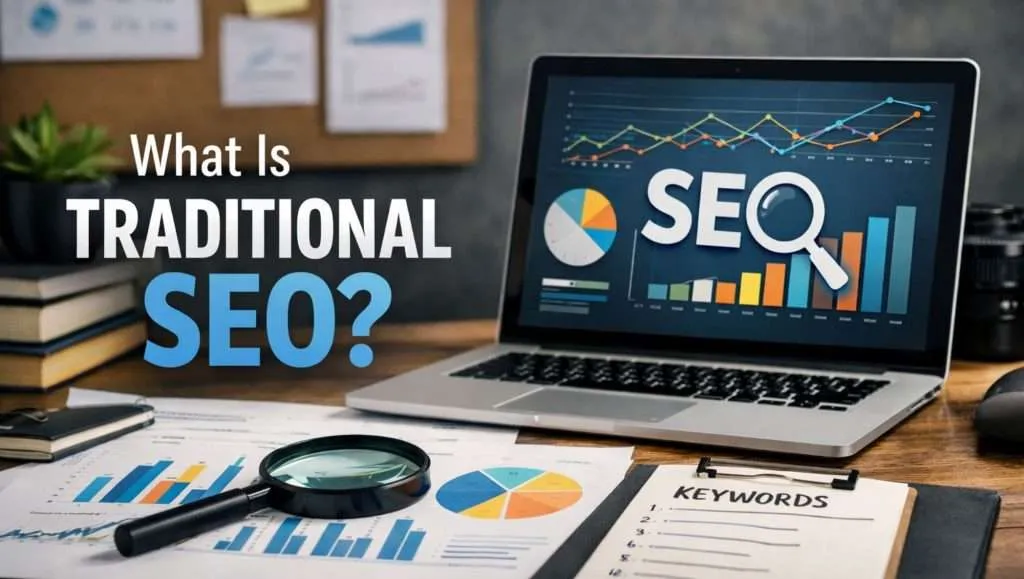
Traditional SEO involves the manual processes that have been the backbone of search engine optimization for over a decade. This includes:
- Keyword research
- On-page optimization
- Backlink outreach
- Technical audits
- Monthly ranking reports
Traditional SEO providers follow established frameworks to build organic search strategies, such as:
- Manually researching keywords
- Optimizing individual pages
- Tracking rankings month by month
- Adjusting strategies reactively
However, traditional SEO has limitations:
- Slow data processing
- Limited forecasting capabilities
- Slow reactions to algorithm changes
- Time-intensive scaling
This is where AI SEO steps in.
What is AI SEO? The 2026 Revolution
AI SEO integrates artificial intelligence at every stage of the optimization process. Rather than analyzing small datasets, AI-powered SEO processes vast amounts of data in real-time.
Some of the key benefits include:
- Automated keyword clustering
- Detecting shifts in search intent
- Predicting ranking volatility
- Identifying content gaps
- Forecasting traffic growth
Generative AI also enhances content creation by suggesting structures, FAQs, and semantic coverage.
AI SEO doesn’t replace traditional SEO—it complements it with automation and predictive insights. Any modern SEO agency in 2026 must use AI to remain competitive.
AI SEO vs Traditional SEO: A Side-by-Side Comparison (2026)
| Area | Traditional SEO | AI SEO |
|---|---|---|
| Keyword Research | Manual research using standard tools | AI-powered clustering based on intent |
| Data Processing Speed | Hours or days of analysis | Real-time AI modeling and automated insights |
| Search Intent Mapping | Basic manual categorization | Machine learning-based intent grouping |
| Content Optimization | Manual updates and audits | AI-driven suggestions for structure, semantics, and topics |
| Technical SEO | Periodic manual audits | Continuous AI monitoring and automated error detection |
| Reporting | Static monthly reports | Live dashboards with predictive forecasting |
| Scalability | Labour-intensive growth | Rapid scaling across multiple markets and keyword clusters |
| Adaptation to Algorithm Updates | Reactive adjustments | Predictive modeling and fast strategic pivots |
| Local SEO | Manual suburb targeting | AI identifies geo-level opportunities for small businesses |
| Integration | Often siloed from paid media | AI SEO integrates with paid ads, CRO, and analytics |
| Cost Efficiency | Higher labor costs | More efficient resource allocation through automation |
| Competitive Intelligence | Limited competitor snapshot | Real-time AI identifies competitor gaps |
Why This Matters for Australian Businesses?
SEO in Australia is fiercely competitive, particularly in industries like:
- Finance
- Construction
- Health
- Legal
- eCommerce
Waiting for manual reports can mean missed opportunities. AI-powered SEO helps businesses:
- Identify gaps in opportunities faster
- Adjust quickly to changes in search behavior
- Forecast revenue growth
- Align SEO strategies with business goals
For small businesses, this precision is even more important—smaller budgets require targeted, cost-effective solutions.
Traditional SEO providers who don’t incorporate AI may struggle to keep up in 2026.
How AI-Powered SEO Works
To fully grasp the operational difference between traditional SEO and AI SEO, it’s crucial to look at how AI is woven into each stage of optimization. AI doesn’t replace SEO fundamentals—it enhances them with speed, scale, and predictive intelligence.
Step 1: Large-Scale Data Aggregation and Pattern Detection
Traditional SEO typically works with a limited dataset. AI SEO processes thousands of keywords, competitor data, user behavior, click-through patterns, and technical metrics, identifying trends across an entire keyword ecosystem.
For instance, AI can detect:
- Emerging topics before they trend
- Declining content performance
- Keyword cannibalization
- Competitor gaps in real time
Step 2: Intelligent Keyword Clustering and Intent Mapping
Instead of targeting individual keywords, AI SEO groups keywords into intent-based clusters, like:
- Informational intent
- Commercial intent
- Transactional intent
- Local intent
This allows for precision targeting, especially in local SEO, where AI can detect regional or even suburb-level keyword gaps—something hard to achieve manually.
Step 3: Predictive Modeling and Opportunity Forecasting
AI SEO introduces forecasting to the mix. It uses predictive modeling to estimate:
- Ranking probability
- Traffic growth potential
- Conversion likelihood
- Seasonal impacts
- Algorithm volatility risk
This lets SEO agencies prioritize high-value actions over less impactful tasks.
Step 4: Content Optimization with Generative AI
Generative AI enhances content optimization by analyzing top-ranking pages and suggesting improvements for:
- Structure
- Semantic keyword coverage
- Internal linking
While AI provides suggestions, human experts ensure quality and ensure the content aligns with the brand voice and compliance standards.
Step 5: Continuous Technical Monitoring
Unlike traditional quarterly audits, AI systems continuously monitor:
- Crawl errors
- Broken links
- Page speed issues
- Mobile usability
AI identifies risks early, preserving long-term SEO stability.
Step 6: Cross-Channel Integration
AI SEO seamlessly integrates with other digital marketing efforts, like:
- Paid ads
- Conversion rate optimization
- Analytics
AI evaluates how SEO and paid strategies can work together, improving overall performance and reducing costs.
Step 7: Automated Reporting with Strategic Interpretation
Rather than static monthly reports, AI SEO provides:
- Real-time dashboards
- Predictive insights
- Behavior-based data
This information is then interpreted strategically to guide decisions that align with business goals.
Tools & Resources to Strengthen Your SEO Strategy
 To evaluate your SEO approach, check out resources like:
- Is Your SEO Strategy Just a Waste of Money?
- AAI-Powered Social Ads
These will help you assess whether your SEO team is using AI-driven systems effectively.
Industry Trends Shaping SEO in 2026
- AI-driven ranking algorithms
- Conversational search
- Predictive analytics integration
- Increased reliance on semantic content clustering
Search engines are increasingly using AI, and businesses relying solely on manual processes risk being left behind.
AI SEO vs Traditional SEO in 2026 — Which Wins?
While traditional SEO is foundational, AI SEO is the future. By 2026, businesses leveraging AI-powered SEO will outperform those relying solely on traditional methods. AI adds speed, scalability, and predictive insight, improving keyword analysis, intent detection, and content workflows. When combined with traditional SEO, AI ensures a comprehensive and future-proof strategy.
FAQs
Is traditional SEO obsolete in 2026?
No, traditional SEO is still important for building the foundation of a solid SEO strategy. However, relying only on traditional methods will no longer be enough. AI SEO enhances traditional practices with smarter data processing, predictive insights, and automation.
What makes AI SEO different from traditional SEO?
AI SEO relies on machine learning to analyze large datasets, forecast opportunities, and automate tasks, offering speed and scalability that traditional SEO can’t match. In contrast, traditional SEO involves manual processes and reactive changes.
Do AI SEO replace human SEO experts?
No, AI supports human SEO expertise. AI automates data analysis and identifies trends, but strategy, creativity, and quality control still require human input.
How does an AI SEO agency differ from a traditional SEO company?
An AI SEO agency integrates SEO with paid media, conversion rate optimization, and analytics. It uses AI for predictive modeling, live dashboards, and real-time insights, while traditional agencies focus on static reports and manual ranking improvements.
Is AI SEO more expensive than traditional SEO?
Not necessarily. Although AI systems require an investment, they often result in more efficient resource allocation and higher ROI in the long run.