











Key Insights
- AEO (Answer Engine Optimisation) is the practice of optimising content to appear in answer boxes and featured snippets within search engine results.
- AEO is essential for businesses looking to provide immediate answers to user queries and gain prime visibility in search results.
- Optimising content with structured data, schema markup, and targeting long-tail queries improves the chances of appearing in AI-generated summaries and direct answers.
- AEO is particularly effective for attracting high-intent traffic, enhancing conversion rates through featured snippets.
- This guide will help you dive deep into AEO and show you how to tailor your content to align with 2026’s search trends.
Introduction
As we move into 2026, Answer Engine Optimisation (AEO) has become a crucial strategy for businesses wanting to appear in featured snippets and answer boxes. These AI-driven tools are revolutionising how users get answers directly at the top of search results. In this comprehensive guide, we’ll explain what AEO is, why it’s vital for Australian businesses, and how to optimise your content to increase visibility in AI-powered answer engines like Google’s Featured Snippets and Answer Boxes.
Table of Contents
- What Is AEO and Why Does It Matter?
- Key AEO Ranking Factors
- How AEO Works: Demystifying Featured Snippets
- Best Practices for AEO
- Essential Tools and Resources for AEO
- Industry Trends and the Future of AEO
- Conclusion
- Frequently Asked Questions
What Is AEO and Why Does It Matter?
AEO (Answer Engine Optimisation) is a specialised form of SEO aimed at optimising content for display in answer boxes, featured snippets, and other direct answers generated by search engines like Google. The goal of AEO is to position your content as the most accurate and relevant response to user queries, ensuring it appears at the top of search results.
In traditional SEO, the primary objective is ranking for specific keywords and driving clicks to your website. However, AEO focuses on getting your content featured directly in answer boxes and snippets, which are often positioned above organic search results. These AI-powered features give users immediate answers without needing to visit a website, making AEO increasingly important in modern search.
Optimising for AEO enables businesses to capture high-intent traffic, as users interacting with answer boxes typically have specific queries and are seeking quick solutions. By securing a spot in these coveted AI-driven features, businesses can boost conversion rates and engagement.
Key AEO Ranking Factors
To increase your chances of getting featured in answer boxes and AI-generated summaries, you need to focus on several ranking factors that search engines use to determine what content is displayed. Here are the key AEO ranking factors:
- Content Structure
Search engines prioritise content that is easily scannable and straightforward for AI tools to extract. To enhance your AEO potential, structure your content with:- Clear headings and subheadings for easy navigation
- Bullet points or numbered lists to break down complex information
- Concise, direct answers at the start of your content to address user queries promptly
- Relevance to User Intent
AEO relies heavily on aligning your content with user intent. Search engines like Google are focused on understanding what the user truly wants and delivering the most relevant, detailed content. Content addressing long-tail, specific queries is more likely to get featured in answer boxes. - Schema Markup
Schema markup plays a critical role in AEO by helping search engines interpret the structure of your content. Using the FAQ schema, How-To schema, and Article schema enhances AI systems’ ability to pull your content and display it as a direct answer. - Content Authority
Search engines tend to favour authoritative content. For better AEO opportunities, your website should demonstrate expertise on the topic through credible backlinks and expert insights. This signals to AI engines that your content is trustworthy and authoritative. - Content Freshness
AI engines tend to prefer updated, relevant content. Regularly revising your content to reflect current trends, statistics, and data will improve its chances of ranking in AEO features.
How AEO Works: Understanding Featured Snippets
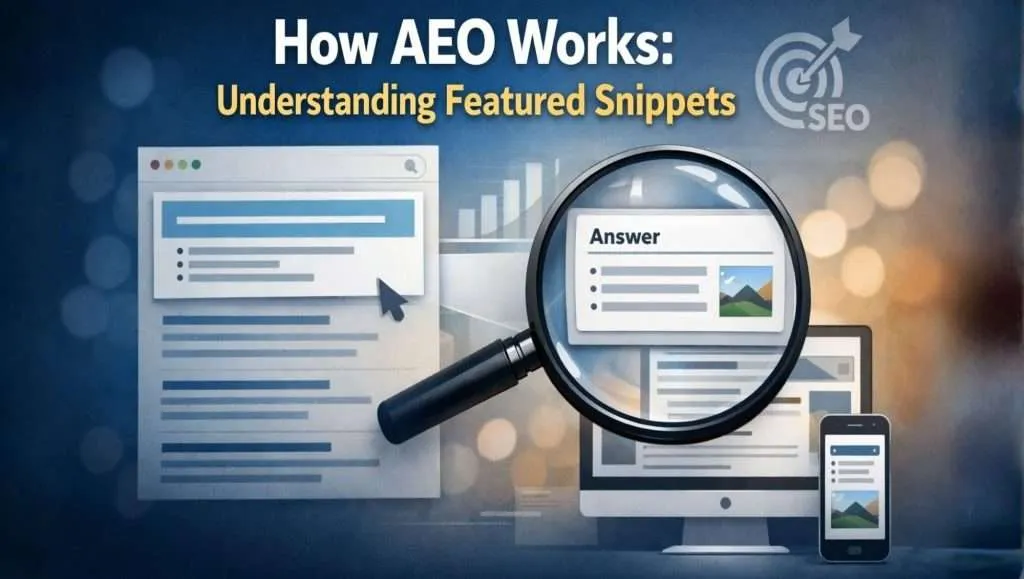
A featured snippet is a search result that gives users an immediate answer to their query. These snippets appear at the top of Google’s search results in various formats:
- Paragraph Snippets: Concise answers to questions in a paragraph form.
- List Snippets: Content formatted as a numbered or bulleted list.
- Table Snippets: Information displayed in a table format.
- Video Snippets: A video answering the query.
To secure a spot in a featured snippet or answer box, your content must be well-structured and optimised for one of these formats. It should also provide a clear, valuable answer that directly addresses the user’s query.
Search engines use natural language processing (NLP) to assess whether your content is a relevant response. By organising your content properly and providing a succinct, direct answer, you increase your chances of being chosen for a featured snippet.
Best Practices for AEO
To improve your chances of appearing in featured snippets or answer boxes, follow these best practices for AEO:
- Target Long-Tail Queries
Optimise for specific, long-tail keywords that align with common user questions. These queries are more likely to trigger featured snippets. Examples of long-tail queries include:- “How can I optimise my website for AEO?”
- “What are the best practices for implementing FAQ schema?”
- Provide Clear, Direct Answers
Start your content with a straightforward response to the user’s query. Keep your answers short, actionable, and easy to digest. - Use Schema Markup
Incorporate schema markup on your pages to help AI engines understand your content. For example:- FAQ Schema: Ideal for questions and answers.
- How-To Schema: Great for step-by-step guides.
- Article Schema: Provides context for articles.
- Keep Content Fresh
Regularly update your content to keep it relevant and aligned with industry trends. Fresh content is more likely to be featured in AI-driven answer boxes. - Organise Content for Easy Extraction
Structure your content in a way that makes it easy for AI to pull key information. Use bullet points, numbered lists, and short paragraphs that are easy to extract and display.
Tools and Resources for AEO
 To streamline your AEO optimisation efforts, here are some essential tools:
- Google Search Console
Track your website’s performance and discover which queries trigger featured snippets. This tool also helps monitor impressions and clicks for specific snippets. - SEMrush & Ahrefs
These tools offer valuable insights into competitor strategies and long-tail queries. Use them to identify content gaps and optimise your site for AEO. - Schema Markup Generators
Tools like Merkle’s Schema Markup Generator can help you implement the appropriate schema for FAQs, How-Tos, and Articles. - Surfer SEO
Surfer SEO provides optimisation suggestions for both SEO and AEO, helping you refine your content structure for better AI compatibility.
Industry Trends and the Future of AEO
As AI-driven search continues to evolve, AEO will become even more critical for gaining visibility in search results. Key trends to watch include:
- Dominance of AI in Search
AI tools like Google AI and ChatGPT are becoming the primary means of information retrieval. Optimising for AEO ensures your content appears in AI-driven search results. - Voice Search and Conversational Queries
With the rise of voice search, it’s essential to optimise your content for natural, conversational queries, making it easier for AI to pull your answers for voice-driven searches. - Increasing Importance of Content Authority
AI systems will continue to prioritise authoritative content. To stay ahead, your business should focus on establishing expertise and backing your content with credible sources.
Conclusion
Answer Engine Optimisation (AEO) is a vital strategy for businesses seeking to maximise their presence in the AI-driven world of search. With tools like Google AI, ChatGPT, and others shaping how users find information, AEO ensures your content is directly featured in answer boxes and snippets—prime spots at the top of search results.
Optimising for AEO means crafting content that is AI-friendly and can be quickly cited as the definitive answer to users’ queries. This approach will not only increase your visibility in search results but also help attract high-quality, engaged traffic.
At DigiTotal, we understand the power of AEO and can help you optimise your content for maximum AI-driven visibility. Let’s collaborate on an AEO Strategy Audit to fine-tune your content and stay ahead in the fast-evolving digital landscape.
FAQs
What’s the difference between AEO and traditional SEO?
AEO focuses on getting your content featured directly in answer boxes and featured snippets, providing direct responses to user queries. In contrast, traditional SEO is focused on ranking content in organic search results based on keywords.
Why should I focus on AEO for my business?
AEO provides immediate visibility in AI-driven search results, which can significantly enhance your business’s authority and drive relevant, high-quality traffic.
How does AEO increase my website’s traffic?
By securing a spot in answer boxes or featured snippets, your content gets prominent visibility at the top of search results, leading to more organic clicks and higher-quality traffic.
What type of content works best for AEO?
Content that offers direct, clear, and concise answers, such as how-to guides, FAQ pages, and listicles, works best for AEO.
How long does it take to see results from AEO optimisation?
AEO results can take weeks or even months to show. However, once your content starts appearing in featured snippets, you’ll notice an immediate increase in visibility and user engagement.
Can AEO improve my SEO rankings?
Yes! AEO can indirectly boost SEO by driving higher user engagement and lowering bounce rates, which sends positive signals to search engines and can improve overall rankings.