












Key Takeaways
- Voice search is becoming increasingly popular in Australia, driven by voice assistants like Siri, Alexa, and Google Assistant.
- Voice search optimisation focuses on conversational queries, local search, and providing direct answers to user questions.
- Australians are increasingly searching for businesses using “near me” queries, making local SEO crucial for voice search.
- Key strategies include optimising for long-tail keywords, structured data (schema markup), and enhancing your Google Business Profile (GBP) for location-based searches.
- DigiTotal offers a Voice Search Audit to help Australian businesses optimise their content for voice search and improve local visibility.
Introduction
As voice assistants like Siri, Google Assistant, and Alexa become more common in Australian households, businesses must optimise their content for voice search. Voice search optimisation involves focusing on local search, conversational queries, and “near me” searches. In this guide, we’ll explain how to optimise your website for voice search in Australia in 2026, helping you capture more traffic and stay ahead of competitors. Let’s explore the key strategies that can improve your voice search visibility.
Table of Contents
- What Is Voice Search and Why Does It Matter?
- Key Voice Search Ranking Factors
- How Voice Search Is Changing Consumer Behaviour in Australia
- Best Practices for Optimising for Voice Search
- Tools and Resources for Voice Search Optimisation
- Local Voice Search: The Importance of ‘Near Me’ Queries
- Industry Trends in Voice Search for 2026
- Final Thoughts
- FAQs
What Is Voice Search and Why Does It Matter?
Voice search allows users to search the internet using voice assistants like Siri, Google Assistant, and Alexa. Instead of typing queries, users speak their questions or commands, and the assistant provides answers or performs tasks.
In Australia, voice search usage is growing rapidly, with more people relying on voice commands to find local businesses, directions, and services. Studies show over 60% of Australians have used voice search at least once, and this trend continues to rise.
Optimising for voice search is essential because voice assistants use different algorithms than traditional search engines. Voice search favors conversational queries, local results, and concise answers. Without optimisation, businesses risk missing out on a significant portion of potential customers.
Key Voice Search Ranking Factors
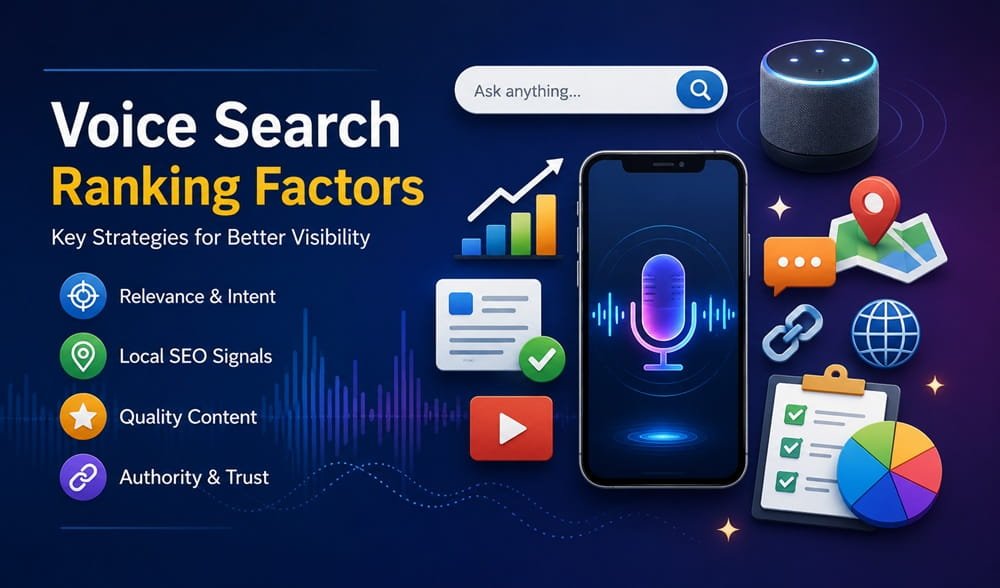
Optimising for voice search requires a different approach than traditional SEO. Key factors include:
- Conversational Keywords
Voice searches are naturally more conversational. Users often ask full questions like:
- “Where is the nearest coffee shop?”
- “How can I find a plumber near me?”
Include natural language and long-tail keywords that match common voice queries, such as “best pizza restaurant in Sydney” or “cheap car hire near me.”
- Local SEO
Local businesses benefit most from voice search, as many queries are location-based, such as “near me” or “open now.” Effective local SEO strategies include:
- Optimising your Google Business Profile (GBP)
- Including your location in content
- Adding location-specific long-tail keywords
- Encouraging local reviews and ratings
- Featured Snippets and Direct Answers
Voice assistants often pull responses from featured snippets or direct answers in SERPs. Optimise content to provide concise answers and use schema markup so AI tools understand your information.
- Page Load Speed and Mobile Optimisation
Voice search is mostly mobile-driven. Slow websites are penalised by both search engines and voice algorithms. Ensure your website:
- Loads quickly on mobile
- Uses AMP (Accelerated Mobile Pages) for faster content delivery
How Voice Search Is Changing Consumer Behaviour in Australia
Voice search is transforming how Australians find information and interact with businesses:
- Increased Local Searches – Users frequently search for nearby businesses using “near me” queries. Local SEO is essential to capture this traffic.
- More Conversational Queries – Users ask questions naturally, so keyword strategy should reflect spoken language rather than typed phrases.
- Faster, Immediate Results – Voice search provides instant answers. Businesses should offer clear, concise, and actionable information in short paragraphs or lists.
Best Practices for Optimising for Voice Search

- Optimise for Natural Language and Long-Tail Keywords – Use conversational phrases like:
- “Where can I find a dentist in Melbourne?”
- “What are the best vegan restaurants near me?”
- Improve Local SEO – Ensure your business is easy to find:
- Optimise your Google Business Profile
- Include location-based content
- Build local citations and encourage reviews
- Implement Structured Data (Schema Markup) – Schema helps voice assistants identify:
- Location details
- Events
- Products and services
- Ensure Mobile Optimisation – Voice searches are primarily on mobile devices, so speed and usability are critical.
Tools and Resources for Voice Search Optimisation
- Google Search Console – Track voice search performance and identify mobile or indexing issues.
- SEMRush & Ahrefs – Keyword research for long-tail queries and site audits.
- Schema Markup Generator – Tools like Merkle’s generator help implement structured data for voice search.
- Moz Local – Enhance local SEO for better visibility in location-based voice searches.
Local Voice Search: The Importance of ‘Near Me’ Queries
“Near me” searches dominate voice queries in Australia, such as:
- “Where can I get a coffee near me?”
- “Find a plumber near me open now”
To optimise for these:
- Fully optimise your Google Business Profile with accurate location info
- Use local long-tail keywords like “best pizza delivery in Sydney”
- Encourage local reviews to build trust and increase visibility
Industry Trends in Voice Search for 2026
- Rise of Voice-Activated Shopping – Australians are increasingly using voice to purchase or inquire about products.
- Growth of Voice Assistant Queries – Voice searches will become more integrated into daily life.
- More Personalised Results – Optimise content for hyper-local searches to remain competitive.
Final Thoughts
Optimising for voice search is essential for businesses aiming to stay competitive in 2026. Key takeaways:
- Focus on local search to capture “near me” queries
- Create content that reflects conversational queries
- Use long-tail keywords likely to trigger voice answers
- Implement mobile optimisation and structured data
In Australia, where local search drives traffic, making your business voice-search friendly increases visibility and captures a larger share of the market.
At DigiTotal, we specialise in voice search and local SEO. Our Voice Search Audit ensures your business is optimised for AI-powered voice search, boosting visibility, attracting qualified traffic, and improving conversions.
FAQs
What is voice search, and why is it important?
Voice search allows users to find information using assistants like Siri, Google Assistant, and Alexa. Optimising helps capture local traffic, enhance user experience, and appear in AI-driven search results.
How do I optimise my content for voice search?
- Use natural language and conversational long-tail keywords
- Answer questions clearly
- Optimise for local search with location-specific keywords and a complete Google Business profile
- Structure content with headings, bullet points, and schema markup
- Ensure mobile optimisation and fast loading
What is a “near me” search?
A query targeting local businesses nearby, e.g., “Find coffee shops near me.” Optimise using local SEO, GBP updates, and location-based content.
How long to see results?
Typically a few weeks to months, depending on current SEO status, industry competition, and search frequency. Track improvements with Google Search Console.
Can voice search improve local SEO?
Yes. Many voice queries are location-based. Optimisation increases visibility in local results and AI-driven summaries, encouraging customer engagement.
What devices use voice search in Australia?
- Smartphones (iPhone with Siri, Android with Google Assistant)
- Smart speakers (Amazon Echo, Google Home)
- Smart TVs and other voice-enabled devices