












As an eCommerce brand, whether small, medium, or large, there will come a time when you’ll need to explore listing your products on a marketplace.
Yet, creating and managing your listings on these platforms can be a complex task, with numerous factors to consider. On top of that, ensuring your product listings are optimized for search engines and can be easily indexed is crucial.
To effectively optimize your product listings, you’ll need a balanced approach that combines a strong SEO strategy with the technical aspects of listing management.
With that in mind, let’s dive into one of the key SEO strategies every product seller should know when it comes to marketplace selling — Marketplace SEO.
Chapter 1
What is Marketplace SEO?
Whether you’re new to selling or an experienced seller, navigating a marketplace can be quite a ride. Success requires the right mix of content, product details, and marketing fundamentals to drive revenue.
Marketplace SEO refers to optimizing product listings on eCommerce marketplaces to boost their visibility and drive conversions. While this may sound similar to general SEO, marketplace SEO is unique due to the specific demands and structure of these platforms, which differ from traditional websites.
Like any other website, a marketplace needs to cover the basics of SEO, such as a well-organized site structure, on-page SEO, and all the necessary elements to help web pages rank. When executed correctly, a marketplace SEO strategy ensures that your product listings are easily discoverable by both buyers and search engines.
While marketplace SEO can be complex, it’s a powerful tool for driving sales. A tailored SEO approach for the marketplace industry can significantly benefit your business — especially if your competitors aren’t yet utilizing it.
Ideally, your marketplace SEO strategy should integrate various digital marketing channels, metrics, and a multi-channel marketing approach to maximize its impact.
Chapter 2
How Marketplace SEO Works
One of the standout features of any successful marketplace is its ability to attract a large number of both buyers and sellers. This influx of qualified traffic is largely driven by a solid SEO strategy that benefits both the marketplace itself and its individual sellers.
As a seller, your first step in attracting buyers is to understand their pain points. For example, if you’re a Melbourne-based real estate business listing properties on one of the industry’s largest marketplaces, your customers might struggle to find properties that meet their specific criteria, whether it’s location or budget.
To effectively reach these customers, you’ll need to optimize your listings with detailed information that addresses their needs. Incorporating relevant keywords into your content and optimizing it for SEO will help your listings rank higher for the right search queries.
While marketplaces invest heavily in attracting sellers, simply using the right keywords is an oversimplification. Marketplace SEO is intricate and time-consuming, but with the right strategy, driving targeted traffic becomes a much more manageable task.
Chapter 3
What Are the Differences Between Marketplace SEO and eCommerce SEO?
While marketplace SEO is distinct from traditional website SEO, it’s also quite different from a standard eCommerce SEO strategy. But don’t worry — there are many commonalities too!
With traditional SEO, the goal is to optimize content so it ranks for popular search queries that potential customers are likely to use. Marketplace SEO, on the other hand, focuses on attracting customers with clear commercial intent — those actively looking to make a purchase.
Here’s an example to illustrate this difference:
When a user searches for “best wedding outfits,” the search results are typically filled with articles and blog posts offering advice. However, when someone searches for “best bridesmaid dresses online,” the results are more likely to feature product listings from marketplaces.
The challenge for marketplace SEO specialists is much greater than that faced by eCommerce SEO experts. Marketplaces must optimize an enormous volume of products, compared to the relatively smaller product catalog of an eCommerce store built on platforms like Wix.
Because of this, marketplace SEO tends to be more time-consuming and requires constant attention, especially when compared to the simpler SEO strategies for smaller eCommerce websites. Additionally, while eCommerce sites usually have full control over their products — including stock, quality, and pricing — marketplaces often need to account for third-party vendors, which introduces risks and additional complexities.
This leads to the need for more effective monitoring and better control systems when implementing SEO strategies on marketplaces.
On the technical side, there are key differences between marketplace SEO and traditional SEO. The aspects of a marketplace website that require optimization are different — and often more numerous — than those in a typical SEO strategy.
When optimizing your content, you must consider the various stages of the marketing and sales funnel. For example, potential customers at the Top of the Funnel (TOFU) are looking for educational or informational content. If your content feels too sales-driven at this stage, it could turn them away.
As users move further down the funnel, some will be close to making a purchase but are still deciding where to buy. You can guide these customers by positioning your marketplace listing as the ideal choice. Finally, customers at the Bottom of the Funnel (BOFU) are ready to purchase and are seeking transactional information. At this stage, a fully optimized product page is crucial to converting these visitors into paying customers.
In the highly competitive marketplace industry, success hinges on having well-optimized listings that cater to each stage of the customer journey, ensuring a higher likelihood of conversion.
Chapter 4
Why is Marketplace SEO Important?
Now, let’s dive into why marketplace SEO is crucial. Before committing to this resource-intensive and time-consuming strategy, it’s important to understand its value. The ability to attract more traffic and customers to your product listings is reason enough to invest in marketplace SEO. But here are some key benefits that highlight its importance:
- Enhance Your Traditional SEO
A marketplace SEO strategy builds upon traditional SEO practices, incorporating additional elements tailored to the unique nature of marketplaces. While traditional SEO helps drive organic traffic and ranks relevant pages for specific search queries, marketplace SEO takes it further by optimizing your listings, ensuring they’re visible to the right customers on the right platforms.
- Establish Trust and Credibility
A strong SEO strategy can help enhance your domain authority. Higher authority improves your search rankings, which in turn drives more traffic to your listings. When you rank higher in search results, it’s easier to convince buyers that your brand is trustworthy. Establishing this credibility helps foster long-term loyalty among customers.
- Earn Better Reviews
With a well-executed marketplace SEO strategy, you’ll ensure your product listings are optimized with the right keywords that align with customer search intent. This makes it more likely for your products to match what buyers are looking for, leading to better reviews. Positive reviews and ratings boost your online reputation, driving more potential customers to your listings and building social proof.
- Generate Sustainable, Cost-Effective Results
Like traditional SEO, marketplace SEO requires an initial investment of time and resources. However, the beauty of marketplace SEO is that it yields long-term results, unlike short-term tactics that can be costly and temporary. You’ll begin to see measurable outcomes within weeks, and once your strategy is in place, you can maintain it with minimal extra investment unless you decide to scale or shift your focus.
- Gain a Competitive Edge
With online marketplaces dominating the eCommerce landscape, platforms like Amazon and Walmart host thousands of sellers. A solid marketplace SEO strategy gives you the tools to stand out, even in highly competitive environments. By optimizing your listings, you increase your chances of competing against even the largest and most established sellers.
Chapter 5
Challenges of Marketplace SEO
While a robust marketplace SEO strategy offers numerous benefits, it also comes with its own set of challenges. Here are some common obstacles you may encounter during the process:
- Managing Large Product Catalogs
While eCommerce websites also deal with a lot of products, they don’t face the sheer scale of product listings that come with selling on an online marketplace. You may have hundreds, if not thousands, of products to optimize for SEO. This is one of the biggest challenges when implementing a marketplace SEO strategy, but with the right team and sufficient resources, it’s manageable.
- Complex Listing Management
Another significant challenge in marketplace SEO is the intense competition you’ll face from potentially hundreds or thousands of other vendors. Marketplace platforms often have stringent policies that sellers must follow, adding another layer of complexity. You will also need to ensure every element of your listings is optimized and properly managed for smooth ongoing operation.
- Effective Product Management
Product management can be a tricky area to navigate. Even when adhering to marketplace guidelines, vendors often make mistakes, such as uploading duplicate product descriptions or using the same URL structure for multiple products. These errors can confuse customers and harm your revenue. To avoid this, constant monitoring of all product listings is essential to catch and correct any mistakes before they affect performance.
Chapter 6
Steps to Create a Stellar Marketplace Listing
If you want to master marketplace SEO, it’s essential to understand what makes an ideal marketplace listing. To help you compete with industry leaders, here are the key steps to creating a well-optimized marketplace listing:
Step 1: Conduct In-Depth Keyword and Market Research
Effective keyword research is the foundation of any SEO strategy, including marketplace SEO. If you already have an SEO plan for your website, start by analyzing your existing keyword data to identify what’s working and where improvements can be made.
You should compare keyword data from search engines with data from your marketplace platform. This will allow you to spot trends in user behavior, helping you focus your keyword strategy. Monitoring the performance of your keywords across these platforms will guide the terms to include in your listings and website.
Additionally, take a close look at the market data related to the products you’re selling. Ask yourself questions like:
- What products are your customers searching for?
- Are your products in high demand?
- Should you expand your catalog with other in-demand products?
You can gather insights by monitoring your website’s search bar or looking at the autofill suggestions. These observations give you a clearer picture of customer needs, and will maximize the effectiveness of your keyword research.
With so much research to manage, it’s easy to feel overwhelmed. However, focusing on the most valuable keywords for your niche and using the right tools to track them will help you build a solid keyword strategy.
Step 2: Optimize Your Product Listings
Your product listings are the most important content on a marketplace, as they directly impact your visibility and sales. Proper optimization of your product pages involves considering various elements, content requirements, and platform algorithms.
Here are the essential aspects to optimize for maximum performance:
- Product Title Optimization
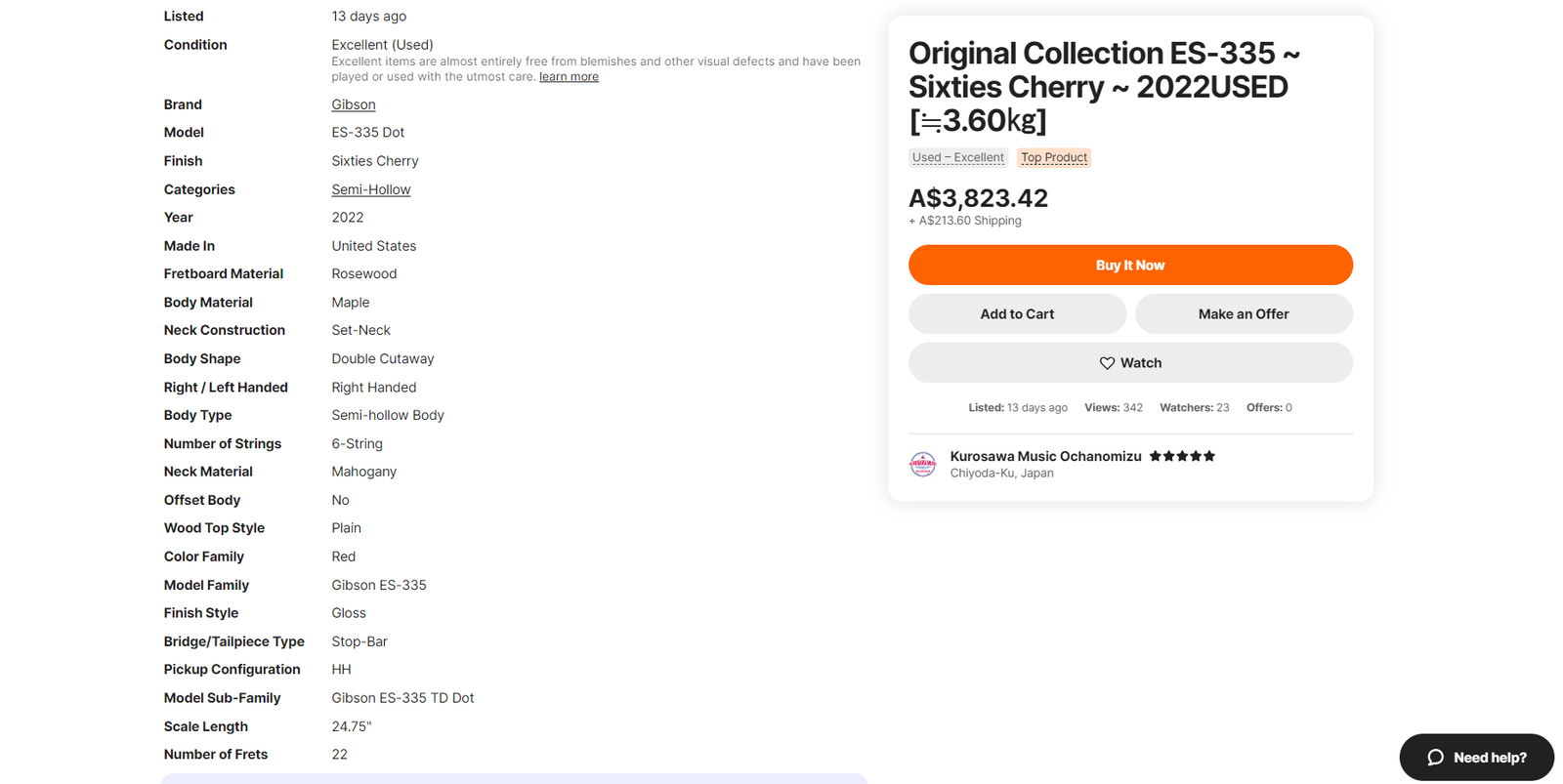
Ensure your product title is concise and under 200 characters. Include the brand name and the main product keyword. Your title should directly match the search intent of potential buyers and highlight relevant product details. Use modifiers (e.g., size, color, model) to make the title even more specific. - Crafting Detailed Product Descriptions
Your description should include the key features and specifications of your product, as well as relevant keywords. For example, if you’re selling a laptop, include details such as processor type, RAM, storage, and unique selling points (USPs). Present these details clearly, ideally in a bullet-point format, and mention any use cases that might help buyers make a purchase decision.

- Leveraging Reviews
Social proof is crucial when selling on a marketplace. Positive reviews build trust and credibility, while addressing negative reviews shows that you care about customer satisfaction. Encourage your customers to leave reviews, and consider offering incentives such as discounts or coupons for feedback. Consistent, high-quality reviews enhance your listing’s visibility and are a key SEO ranking factor. - Implementing Effective Pricing Strategies
While pricing isn’t directly tied to SEO ranking, it is a key factor in the decision-making process. Research competitor pricing for similar products to ensure your prices are competitive. This can also inform the stakeholders who control your pricing decisions.
Step 3: Use High-Quality Images
Along with optimized content, high-quality images are essential for increasing your product’s chances of conversion. Since customers can’t physically touch the products, your images and videos should provide as much detail as possible. Use high-resolution images to showcase the product in the best light.
For products with multiple use cases, consider using videos or images that demonstrate these different scenarios. Don’t forget to add alt text to your images for SEO purposes and include relevant details for accessibility.
Step 4: Build a Strong Link-Building Strategy
Link building plays an important role in marketplace SEO. If you’re in a highly competitive niche, having a solid strategy is crucial. Reach out to websites, blogs, or publications relevant to your products and pitch your listings for inclusion in their content. For instance, if you sell fashion items, connect with fashion trend blogs and offer your products for review or feature.
Backlinks are an important ranking factor, and getting links from reputable sources will help increase the authority of your listings. Over time, these links will improve your product’s visibility on search engines and enhance its credibility, making it easier to rank higher.
Chapter 7
Chapter Eight: Top Marketplace SEO Tips to Boost Your Listings
Now that you know how to optimize your product listings for better SEO performance, let’s take a look at some essential tips you should implement to strengthen your marketplace SEO strategy. These tips will help you improve your product listing performance and enhance your overall visibility in competitive marketplaces.
1. Leverage Data-Driven Keyword Research
If you already have an SEO strategy for your Shopify or WooCommerce site, you’re on the right track. However, conducting keyword research for your marketplace listings is still essential. With proper keyword research, your marketplace product listings can rank higher for relevant search queries.
There are marketplace-specific keyword research tools that can provide valuable data and insights. Use them to find the most effective keywords for your products. Don’t hesitate to perform manual research as well — it’s a great way to discover long-tail keywords. Simply type your product category or relevant search queries into the marketplace search bar and let autofill suggest common terms. This can help you pinpoint the exact keywords customers are using.
2. Incorporate Breadcrumb Navigation
Breadcrumbs are a helpful navigation tool that allows customers to easily track their location within a marketplace. On large platforms with numerous product categories, breadcrumbs are essential for improving the user experience.
If your store offers a wide variety of products, breadcrumbs will guide users through your listings. For instance, if you sell fashion items like dresses, skirts, and blouses, breadcrumbs will help customers navigate through categories like “Casual Wear” or “Evening Dresses,” enhancing their browsing experience.
3. Ensure Mobile-Friendliness
Mobile optimization is critical, as most marketplaces are mobile-first. While the platform you’re selling on is likely responsive, you still need to ensure that your content and media (images, videos) are optimized for mobile devices.
Optimize all the media and content you include in your listings, ensuring that they load quickly and display correctly on smartphones and tablets.
4. Focus on Quality Content
The content on your product listings directly influences your sales. If your content is aligned with the search intent of your customers, they are more likely to click on your product and make a purchase.
For example, when selling a laptop, including detailed specifications and unique selling points (USPs) is a must. Make sure the content is clear, informative, and optimized for the relevant search queries.
5. Make the Most of Customer Reviews
Reviews play a major role in establishing credibility for your product. Encourage customers to leave reviews, as positive feedback boosts trust in your brand. Be sure to respond to both positive and negative reviews — addressing complaints professionally demonstrates your commitment to customer satisfaction.
Customer reviews are not only valuable for building trust but also influence SEO rankings. Regularly collecting reviews and engaging with your customers can significantly improve your listing’s visibility and reputation.
6. Adopt a Localized Content Strategy
To target the right audience, consider a localized content strategy. Integrating location-based keywords like “near me” can help attract customers who are within your delivery zone, improving your chances of converting local buyers.
This localized approach can reduce delivery costs and improve turnaround times, giving you a competitive edge over other sellers targeting broader audiences.
7. Build Backlinks to Your Website
Backlinking remains one of the most effective SEO tactics. While marketplace SEO primarily focuses on your listings, acquiring quality backlinks to your website can improve your overall SEO strategy and boost your rankings.
Reach out to relevant, high-authority websites in your niche and pitch your products for inclusion in their content. High-quality backlinks will help improve your product pages’ authority and search engine visibility.
8. Include Your Company Information
While your product listings are the focal point, including relevant company details is important for building trust. Provide information about your brand, its values, and a link to your website, where customers can learn more about your business and other products you offer.
Including basic NAP (Name, Address, Phone) details can also boost credibility, making your business appear more trustworthy to customers.
9. Be Creative with Your Content
Creativity can help your product listings stand out from competitors. While your product description should be informative, feel free to get creative with how you present your product. Use engaging language and tell a compelling story about your product.
Take advantage of the freedom you have with content length (especially compared to product titles) to integrate long-tail keywords and make the content more appealing. Ensure the copy is clear, easy to read, and highlights the key features and variations of the product.
10. Highlight Key Product Features
Make sure to highlight your product’s most important features in a concise, easy-to-read format. Bullet points are a great way to present product specifications, key features, sizing information, and any use cases or instructions.
For example, if you’re selling a real estate property, include details such as the number of rooms, total area, furniture included, and any other selling points that might convince a potential buyer.
11. Implement a Smart Pricing Strategy
Pricing plays a significant role in how customers perceive your brand. While pricing doesn’t directly impact SEO, it influences click-through rates and conversion rates. Ensure your pricing is competitive but balanced, avoiding prices that are too high or too low compared to the market average.
Be mindful of how other sellers price similar products, especially when marketplaces display prices in search results. A well-structured pricing strategy can make your product more attractive to potential buyers.
12. Add Videos to Boost Engagement
Videos can elevate your product listings by providing customers with a more interactive experience. Videos help showcase your product in action, demonstrate its use cases, and even feature testimonials from satisfied customers.
Including videos not only increases engagement but can also help boost SEO performance, as video content often improves visibility in search results. Videos can replicate the in-store shopping experience, helping customers feel more confident in their purchase decision.
13. Incorporate Content Marketing Principles
A robust content marketing strategy is key to attracting and retaining customers. Your marketplace listings should be an integral part of this strategy, along with other content on your website.
Content marketing can help you engage customers at different stages of their journey. Examples include:
- Detailed product buying guides
- Service guides
- Customer success stories
- Infographics, videos, and other multimedia
These content pieces can improve your product listings’ relevance, reduce bounce rates, and enhance customer engagement, ultimately boosting your marketplace SEO strategy.
Chapter 8
Key SEO Strategies for Marketplaces
So far, we’ve discussed SEO strategies for sellers on marketplaces, but what if you’re the marketplace itself? Optimizing your marketplace for search engines is a whole new level of SEO that can significantly boost your visibility and traffic. Understanding SEO for marketplaces is just as important as for individual sellers. While small businesses need SEO to enhance their product listings, marketplaces need it to elevate their entire platform on the search engine results pages (SERPs).
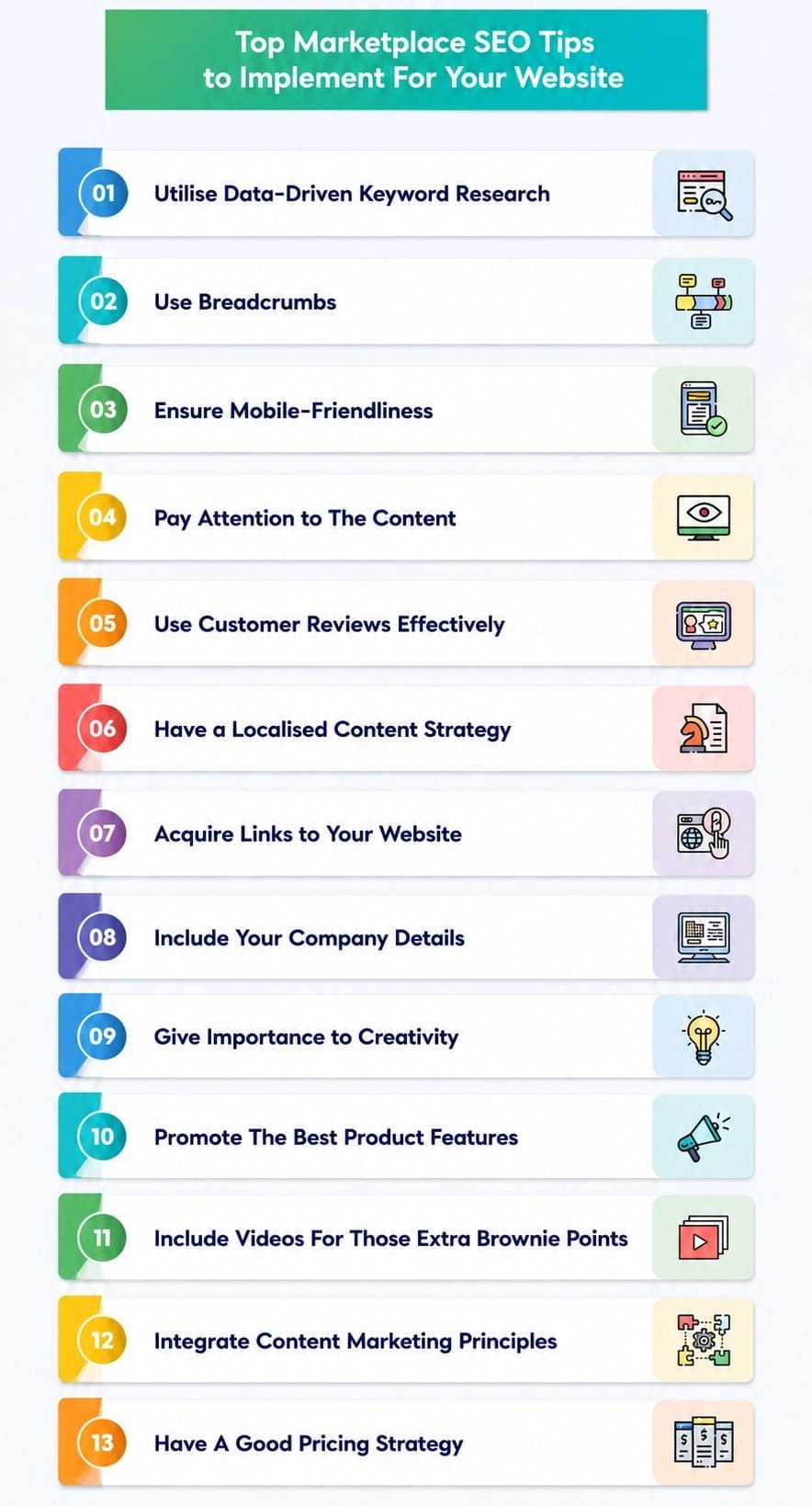
Here are some essential SEO strategies to consider if you’re planning to create a marketplace or want to promote an existing one:
1. Programmatic SEO
Programmatic SEO is essential when managing a large volume of web pages on your marketplace. With countless product pages to optimize, this strategy helps generate pages at scale. Major marketplaces like TripAdvisor or Zillow use this approach for queries like “things to do in Melbourne” or “properties in Melbourne.”
To implement programmatic SEO, you’ll need to start with comprehensive keyword research. Identify common modifiers like size, color, location, etc., that are relevant to your marketplace. Next, work with your development team to create a code template that can generate multiple landing pages quickly. These templates should be customizable to allow for specific information to be added based on further research.
Programmatic SEO can be resource-intensive, but if done right, it will enable you to create hundreds of pages, giving you the ability to target core keywords and commercial terms that drive traffic to your product listings.
2. Indexation Management
Regardless of the size of your marketplace, managing your crawl budget is crucial for maximizing SEO efficiency. Implementing indexation management ensures that search engines prioritize crawling your most important pages.
To do this, consider using multiple sitemaps that target different sections of your marketplace, ensuring high-priority pages are crawled first. This process also helps prevent outdated or expired pages from being crawled, saving valuable crawl budget.
When dealing with outdated pages, redirects and canonical tags are essential. They ensure that search engines focus on the pages that matter most, preventing unnecessary crawls of low-priority content.
3. Schema Markup
Not using schema markup can hurt your marketplace’s SEO performance. Schema markup adds rich data to your website, helping search engines understand your content more effectively.
For a marketplace, schema markup is especially beneficial. For example, product reviews provide Google with valuable data, such as seller ratings, product prices, and features. Implementing schema markup will not only highlight these reviews but also display star ratings directly in search results, making your products more attractive before users even click through to your site.
Positive reviews displayed in this way can significantly boost customer confidence in your marketplace and encourage more sales.
4. International SEO
If your marketplace is targeting customers globally, implementing an international SEO strategy is essential. This strategy helps ensure that your website is optimized to attract customers from different countries and regions.
International SEO involves changes like adjusting your domain structure (e.g., using country-specific domains or subdirectories), integrating language preferences, and conducting keyword research with international terms in mind. By optimizing your site for different markets, you give search engines clear signals about which countries you’re targeting, which can greatly improve your visibility abroad.
Keep in mind that an international SEO strategy can be resource-heavy and time-consuming. However, for a growing marketplace looking to reach global customers, it’s a necessary step to remain competitive and ensure your site is visible across different regions.
Chapter 9
Top Marketplace SEO Examples to Inspire You
Now that you’re familiar with the key strategies a marketplace should adopt to stay competitive, let’s take a look at some standout examples of companies already excelling in the SEO game.
1. Airbnb
When you think of a vacation in a picturesque destination, Airbnb likely comes to mind—and that’s no accident. Their strategic SEO efforts have not only secured them a top spot in search engine results but also in the minds of potential customers.
When planning a trip, people typically use keywords like “vacation rentals,” “stays,” and the specific location they’re interested in, often adding modifiers to narrow down their search.
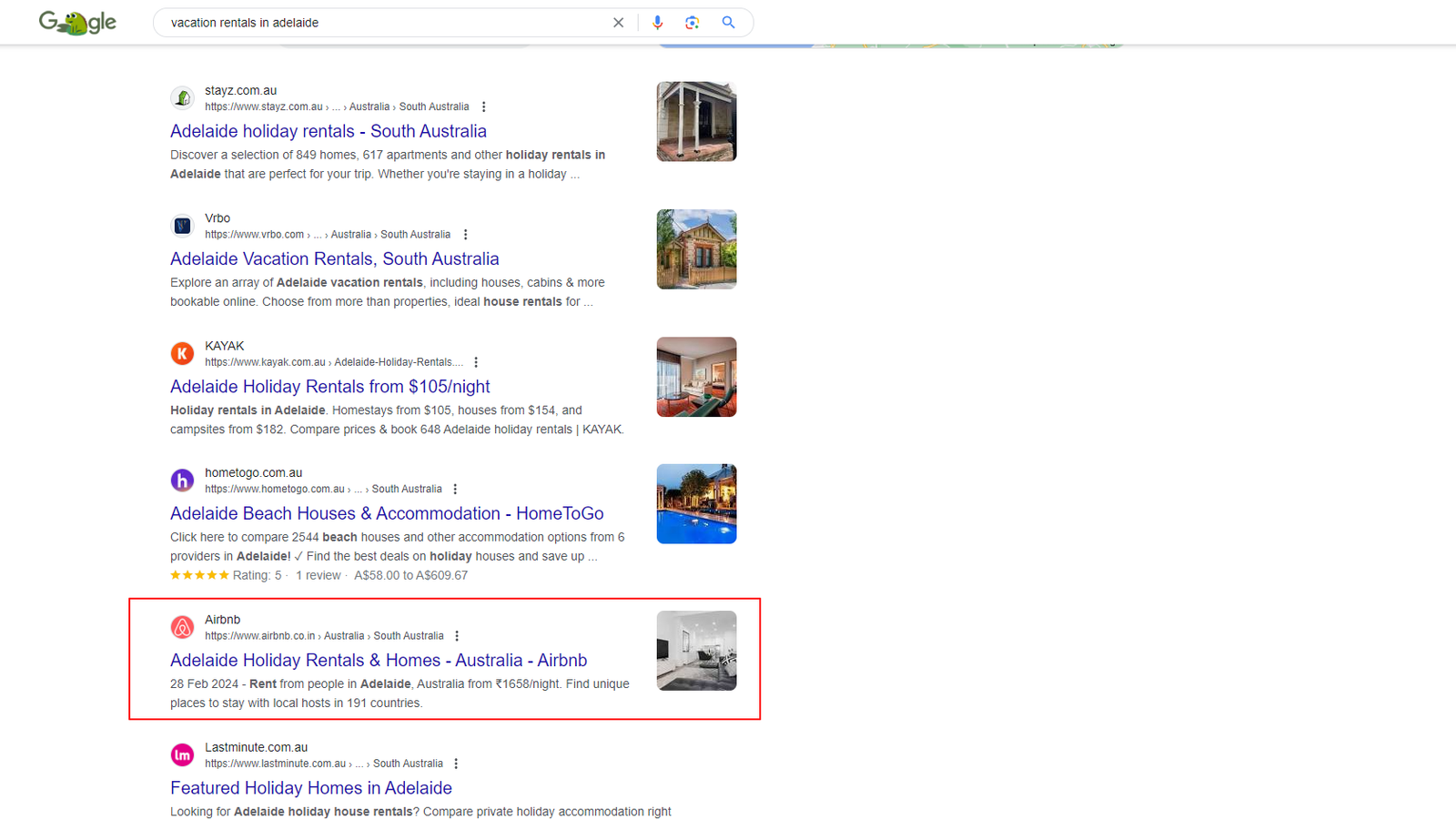
Airbnb has effectively optimized its content with these keywords, ensuring that when customers search for terms like “vacation rentals in Adelaide,” Airbnb’s property listings appear at the top of the results.
This strategy may seem straightforward, but when you consider the vast number of listings Airbnb manages, the scale of this effort becomes clear. Without programmatic SEO, managing such a large volume of listings would be a monumental challenge. But given the rewards, it’s worth the investment of resources and time.
2. Reverb
Reverb is a marketplace well-known in the music community, particularly for buying and selling musical instruments. If you’ve ever searched for an instrument online, chances are you’ve come across Reverb’s listings.
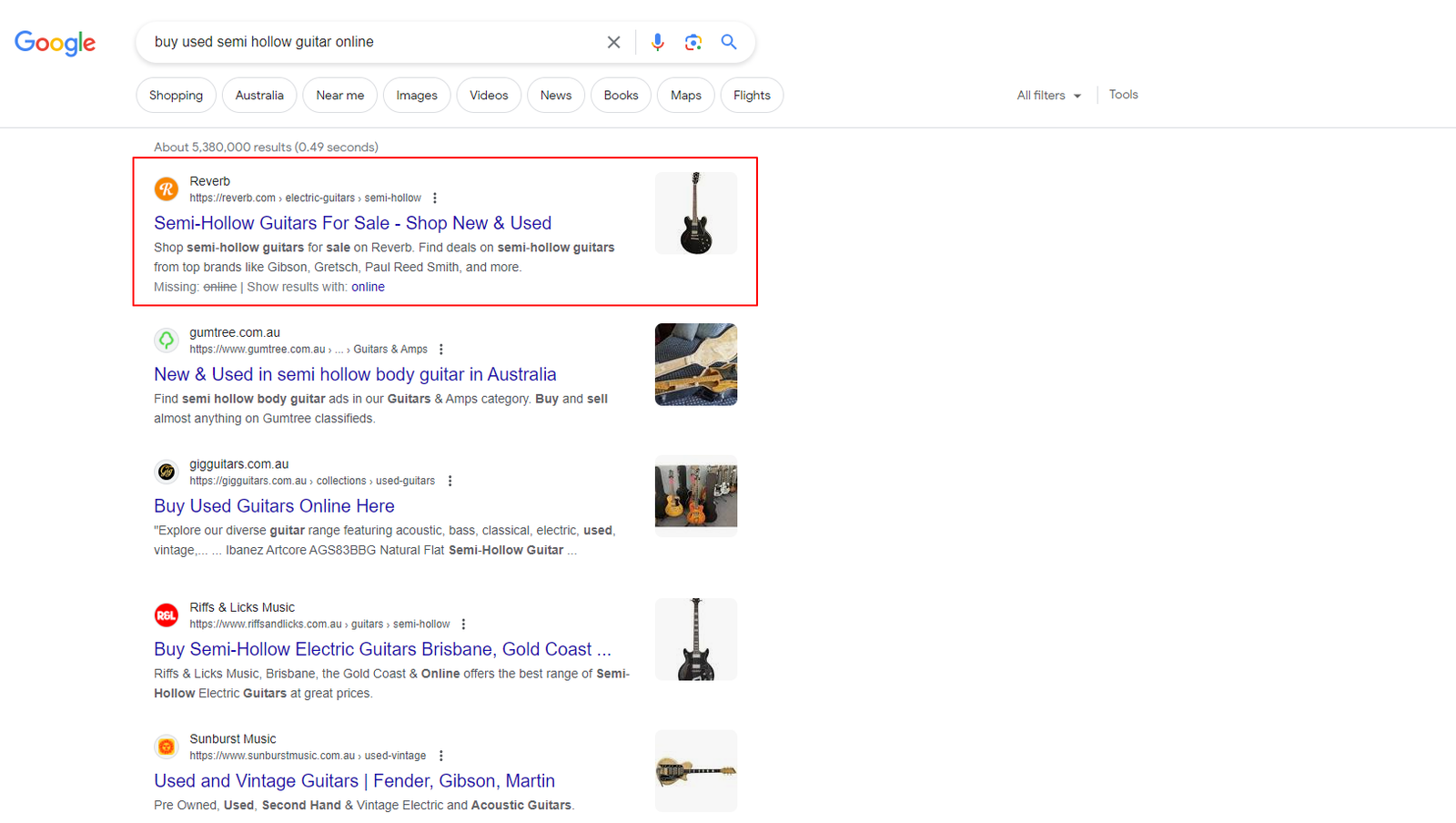
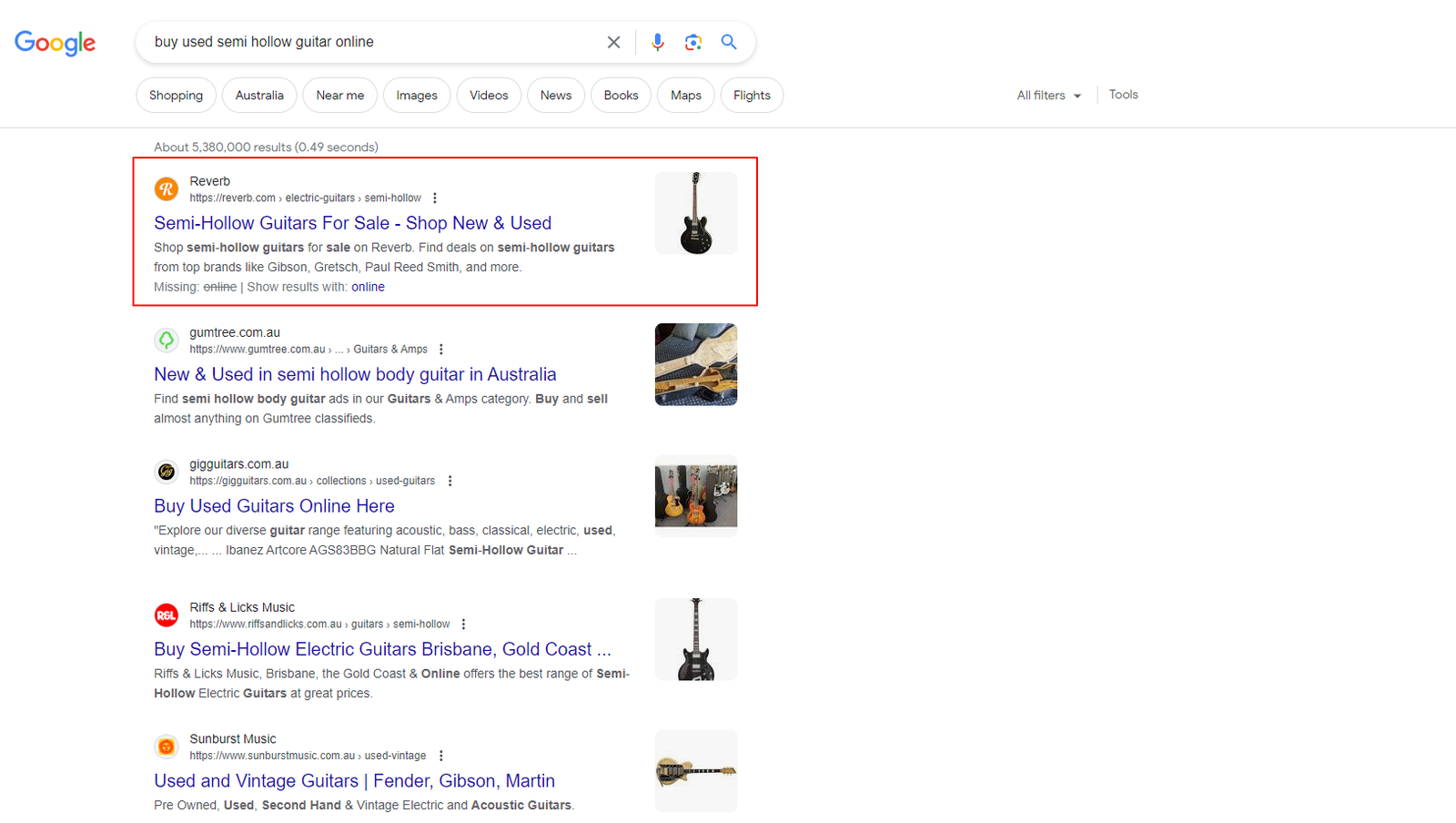
To demonstrate this, we tried searching for “buy used semi-hollow guitar online,” and Reverb’s website was right at the top of the search results.
Reverb’s SEO success stems from its meticulous optimization of each product page. They incorporate high-performance keywords and provide detailed product descriptions that cover everything from the item’s condition to its specifications and seller information, whether the item is new or used. This comprehensive approach ensures Reverb maintains dominance in search results for music and instrument-related queries.
3. Airtasker
Airtasker is a platform that connects people who need tasks done with those who can carry them out—whether it’s something simple like parcel delivery or specialized work like website design.
On the surface, it seems like a concept destined for success. However, Airtasker faces stiff competition from thousands of independent contractors and their individual websites, making SEO critical to standing out in search engine results.
For example, when we searched for “local parcel delivery in Melbourne,” Airtasker appeared among the top results. This is a major achievement, considering the competition from well-established courier companies in the region. Airtasker’s ability to rank for such competitive commercial keywords demonstrates the strength of its SEO strategy, which focuses on optimizing product pages to improve visibility and capture high-traffic terms.
Chapter 10
Boost Your Product Listings with Marketplace SEO
Marketplaces function like vast search engines, with extensive databases focused on specific product categories. Marketplace SEO ensures that your product listings gain the visibility they need, both within the marketplace and across search engines.
By implementing an effective marketplace SEO strategy, you can optimize your listings to attract more sales and build greater authority. As a seller, this is a crucial step you shouldn’t overlook. If you need assistance updating your listings or refining your marketplace SEO approach, reach out to us — we’re here to help!