
Introduction
“Do I need SEO or local SEO?” is one of the most common questions small business owners ask before they spend a single dollar on marketing — and it’s the wrong question to start with, because the answer isn’t either/or. It’s about where your customers actually are and how they search for you.
If you run a national e-commerce store, ranking for broad, high-volume keywords across the country is what pays the bills. But if you run a clinic, a workshop, a restaurant, or any business that serves people who can physically walk through your door, your growth depends on showing up when someone nearby searches “near me” — not on ranking in a city you’ll never serve.
In this guide, we’ll break down exactly how organic SEO and local SEO differ, when each one makes sense, and the specific, up-to-date tactics — including how AI-powered search (Google AI Overviews, Gemini, ChatGPT search) is reshaping local visibility in 2026 — that turn searches into paying customers. By the end, you’ll know exactly which strategy fits your business and the first three actions to take this week.
Book a 15-minute SEO audit call
What Is SEO? A Quick Refresher
Search engine optimisation (SEO) is the practice of improving your website so it ranks higher in organic (unpaid) search results, earning more visibility, traffic, and — ultimately — customers. A well-run SEO campaign typically helps a business:
- Rank higher on search engine results pages (SERPs) for terms customers actually use
- Reach relevant buyers earlier in their decision-making journey
- Convert browsing visitors into leads and paying customers
- Generate data that sharpens every other part of your marketing
SEO remains one of the highest-ROI marketing channels available. Independent industry benchmarking has repeatedly shown organic search returning roughly $2–$3 for every $1 invested over a 12-month period when campaigns are strategy-led rather than “set and forget” — though results vary significantly by industry, competition, and starting point, so treat any blanket ROI figure as a guide, not a guarantee.
If you’re building foundational SEO knowledge, credible resources worth bookmarking include Google’s own Search Central documentation on how search works, Moz’s Beginner’s Guide to SEO, and Ahrefs’ SEO blog — all regularly updated as algorithms change.
Book a 15-minute SEO audit call
SEO vs. Local SEO: The Core Difference
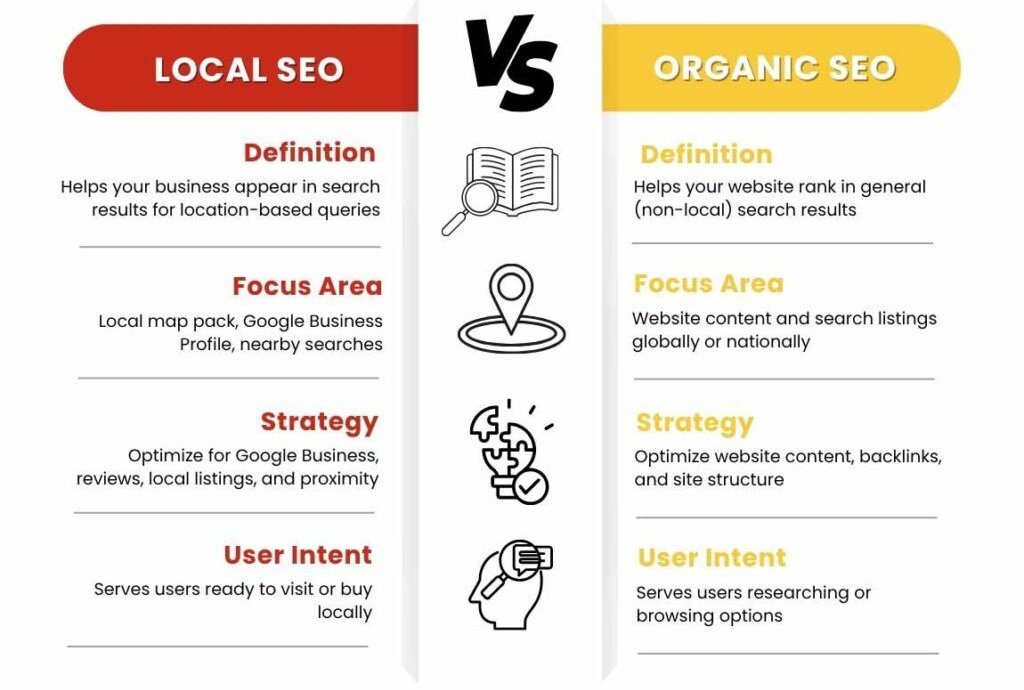
The simplest way to understand the difference is geography and intent.
| Traditional (Organic) SEO | Local SEO | |
|---|---|---|
| Goal | Rank for keywords across a state, country, or globally | Rank for “near me” and location-specific searches |
| Best for | E-commerce, SaaS, national service brands, publishers | Clinics, tradies, restaurants, retailers, any business with a physical location or service area |
| Key ranking factor | Site authority, content depth, backlinks | Google Business Profile, proximity, reviews, local citations |
| Where it shows up | Standard organic results | Google Maps, the Local Pack (map + 3 listings), AI Overviews with local intent |
| Success metric | Organic traffic, rankings, national conversions | Phone calls, direction requests, foot traffic, local leads |
Organic SEO in Practice
Organic SEO campaigns are built to attract, engage, and convert an audience across a broad geography — often an entire country. It’s simpler than it sounds: if your product or service can be delivered to anyone, anywhere, national SEO is usually your best channel.
One nuance business owners often miss: search behaviour is highly regional, even within English-speaking markets. Search volume and terminology change by country — and sometimes by state.
Example: In Australia, “women’s workout tights” attracts strong monthly search volume. In the United States, the same product is searched almost exclusively as “leggings” or “yoga pants.” A campaign that ignores this mismatch wastes budget targeting the wrong phrase for the wrong audience.
If you’re expanding internationally, this is also why global SEO strategies require separate keyword research, separate content, and often separate domains or subfolders per country — not a single one-size-fits-all page.
When Local SEO Is the Right Call
According to Google’s own local search documentation, local ranking is determined primarily by relevance, distance, and prominence — which is why local SEO becomes the priority, not just an add-on, when:
- You operate a physical location. Medical and allied health practices, childcare centres, retail stores, and hospitality venues live or die by local visibility.
- Your offer is time- or region-specific. A EOFY or Labour Day promotion needs geo-targeted content, especially in Australia where public holidays and financial deadlines shift by state.
- You serve a defined service radius. Dentists, mechanics, electricians, and towing companies typically can’t (and shouldn’t try to) rank nationally — their customers are within a 5–30km radius.
Book a 15-minute SEO audit call
Why Local SEO Often Delivers Better ROI for Service Businesses
For most B2B and B2C service businesses, local SEO out-performs broad national SEO on cost-per-lead — simply because you’re not competing with every business in the country for the same click.
Businesses that typically see the strongest returns from a localised strategy include:
- Dentists, GPs, chiropractors, and allied health providers
- Mechanics and automotive repair shops
- Towing and commercial transport services
- Home services: plumbers, electricians, cleaners, landscapers
- Restaurants, cafés, and hospitality venues
What connects them is simple: they serve a defined geographic community and can’t meaningfully extend beyond it. Ranking #1 nationally for “chiropractor” is worthless if 99% of that traffic can’t book an appointment with you. Ranking #1 for “chiropractor Southport” converts.
The same logic applies to online retailers that don’t yet offer international or even interstate shipping — if your fulfilment is capped geographically, your SEO targeting should be too.
For a general primer on planning a marketing strategy as an Australian business, business.gov.au’s digital marketing guidance is a solid, government-backed starting point. And if reviews or testimonials form part of your local SEO strategy, it’s worth reviewing the ACCC’s guidelines on advertising and promoting your business, which cover what you can and can’t do with customer reviews and testimonials under Australian Consumer Law.
Book a 15-minute SEO audit call
How to Maximise Local Search Results in 2026
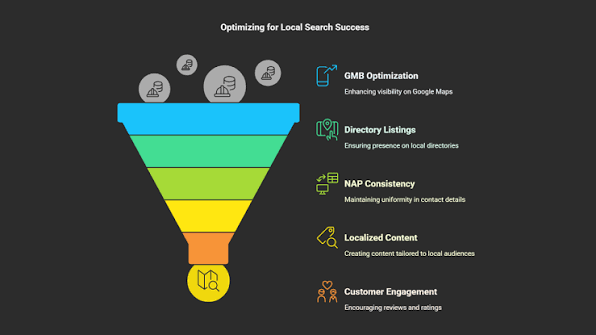
Local search has changed more in the last 18 months than in the previous five years combined, largely because of AI-generated answers. Here’s what actually moves the needle now.
- Claim and Actively Manage Your Google Business Profile (GBP)
Google Business Profile (the current name for what many still call “Google My Business”) is the single biggest local ranking factor — and in 2026, it’s also the primary data source AI systems pull from when answering local queries in Google AI Overviews, Gemini, and increasingly ChatGPT and Perplexity search results.
Treat your GBP like an active social channel, not a set-and-forget listing:
- Keep your name, address, and phone number (NAP) 100% consistent with your website and every directory
- Choose precise, specific categories rather than broad ones
- Post updates, offers, and photos weekly
- Respond to every review — good and bad — within 48 hours
- Keep hours accurate, especially around public holidays
- Build Entity and Trust Signals, Not Just Keywords
Search engines no longer treat your business as “just a website” — they treat it as an entity: a real-world organisation with a consistent identity across the web. This is central to how AI-driven search verifies and recommends businesses in 2026.
Key trust signals to strengthen:
- NAP consistency across your website, GBP, and every directory listing
- Structured data (schema markup) that explicitly tells search engines and AI crawlers who you are, where you’re located, and what you offer (see JSON-LD example below)
- Authoritative citations from local directories, industry associations, and news mentions
- Use Local Keywords With Real Search Intent
Local keyword research still matters, but the winning formula in 2026 blends service + suburb with question-based, conversational phrasing that mirrors how people talk to AI assistants:
- “Car mechanic Melbourne” (traditional)
- “Which mechanic near Bondi Beach does same-day brake repairs?” (AI-search style)
Weave these naturally into page titles, meta descriptions, H1/H2 headers, and body copy — never force-fit a keyword where it breaks readability.
- Earn (and Respond to) Local Reviews Strategically
Reviews are now evaluated by AI systems for content, not just star rating — meaning the actual words customers use matter. A review that says “best emergency dentist in Southport, saw me same day” carries far more local-ranking weight than a five-star rating with no text.
Prioritise generating reviews on:
- Google Reviews (highest local ranking impact)
- Facebook Page reviews (see Meta’s Business Help Center for setup and moderation guidance)
- Industry-specific directories
Tip: If a great review doesn’t mention your suburb, reply and mention it yourself — e.g., “Thanks for visiting our Southport clinic, Sarah!” This reinforces geographic relevance without being spammy.
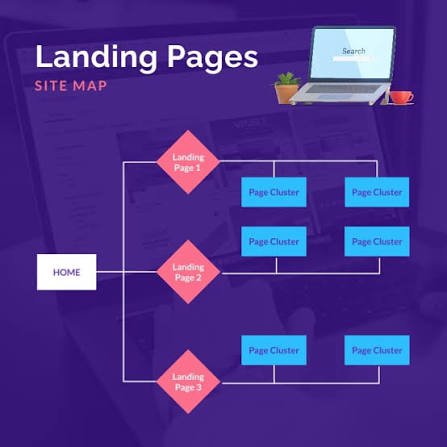
- Build Genuinely Useful Local Landing Pages
If you serve multiple suburbs or regions, build a dedicated page per location — not a copy-pasted template with the suburb name swapped out (Google’s algorithms and AI crawlers both penalise this pattern).
Each local landing page should include:
- Unique content addressing that area’s specific needs
- Local landmarks, testimonials from clients in that suburb, and embedded maps
- Location-specific FAQs
- Locally optimised title tags, meta descriptions, and H1s
Example: An automotive repair business servicing three suburbs should have three distinct pages, each genuinely written for “car repair [Suburb Name],” not a mail-merge variant of one master page.
- Optimise for AI Overviews and “Search Everywhere”
By 2026, a meaningful share of local discovery now happens outside the traditional Google results page — inside AI Overviews, Gemini conversations, and even social platforms like TikTok and Instagram. This doesn’t replace local SEO; it extends it. To stay visible across all of these:
- Structure content in clear, direct question-and-answer format (this is exactly what AI Overviews pull from)
- Add FAQ schema so search engines can lift concise, accurate answers directly from your page
- Maintain an active presence on the platforms your customers actually browse, not just Google
- Keep your Google Business Profile and website facts perfectly aligned — AI systems cross-check for consistency before recommending a business
- Don’t Neglect the Technical Basics
- Mobile-first design: most local searches happen on mobile, often with call-or-visit intent
- Page speed: slow-loading local pages lose both users and rankings
- Local schema markup: LocalBusiness, Service, and FAQ schema (examples below) help both traditional search engines and AI models understand your business accurately
Book a 15-minute SEO audit call
SEO vs. Local SEO: Which One Should You Choose?
A simple gut-check:
- Choose national/organic SEO if customers anywhere in the country (or world) can buy from you without visiting a physical location.
- Choose local SEO if your customer needs to visit you, or you can only service a defined geographic area.
- Choose both if you’re a multi-location or hybrid business — e.g., an e-commerce brand with retail showrooms, or a national brand with franchised local branches.
Most small and medium businesses in Australia fall into the second or third category — which is exactly why a blended, locally-weighted strategy tends to outperform a purely national approach.
Frequently Asked Questions
Is local SEO more affordable than national SEO?
Generally, yes. Local SEO campaigns target a smaller, more specific audience with less competition than national keywords, which typically means a lower cost-per-lead and a faster path to page-one rankings for service-area businesses.
Do I need both SEO and local SEO?
If you have a physical location or service area and sell products or services online more broadly, a blended strategy usually performs best — local SEO drives nearby foot traffic and calls, while broader SEO builds long-term authority and national visibility.
How long does local SEO take to show results?
Most businesses start seeing measurable movement in local rankings and Google Business Profile visibility within 3–4 months, with stronger, more stable results typically building over 6–12 months of consistent optimisation.
What’s the difference between Google Business Profile and local SEO?
Google Business Profile (formerly Google My Business) is one component of a local SEO strategy — an essential one — but full local SEO also includes on-site local keyword optimisation, citations, reviews, local content, and technical schema markup.
Does local SEO help with AI search results like Google AI Overviews or ChatGPT?
Yes. AI-driven answer engines rely heavily on structured, verified data — your Google Business Profile, schema markup, and consistent NAP information across the web — to decide which local businesses to recommend, making strong local SEO foundations directly relevant to AI visibility.
Can a small business realistically compete with larger competitors in local search?
Absolutely. Local search rewards relevance and trust signals (reviews, proximity, accurate information) more than raw domain size, which is why well-optimised small businesses regularly outrank much larger national competitors in their own suburb or city.
Conclusion
SEO and local SEO aren’t competing strategies — they’re different tools for different jobs. Organic SEO builds visibility and authority across a broad audience; local SEO puts you in front of the customers standing closest to your door, at the exact moment they’re ready to call, visit, or book. Get the distinction right, and every dollar you spend on marketing works harder, because it’s reaching people who can actually become customers.
The businesses winning in 2026 aren’t choosing one over the other by default — they’re matching their strategy to how their real customers search, and building the trust signals (Google Business Profile, reviews, schema, consistent local content) that both search engines and AI platforms now rely on to recommend a business.
Not sure which strategy fits your business? Book a free 15-minute intro call with DigiTotal’s SEO team, and we’ll map out exactly where your leads are searching — and how to reach them first.