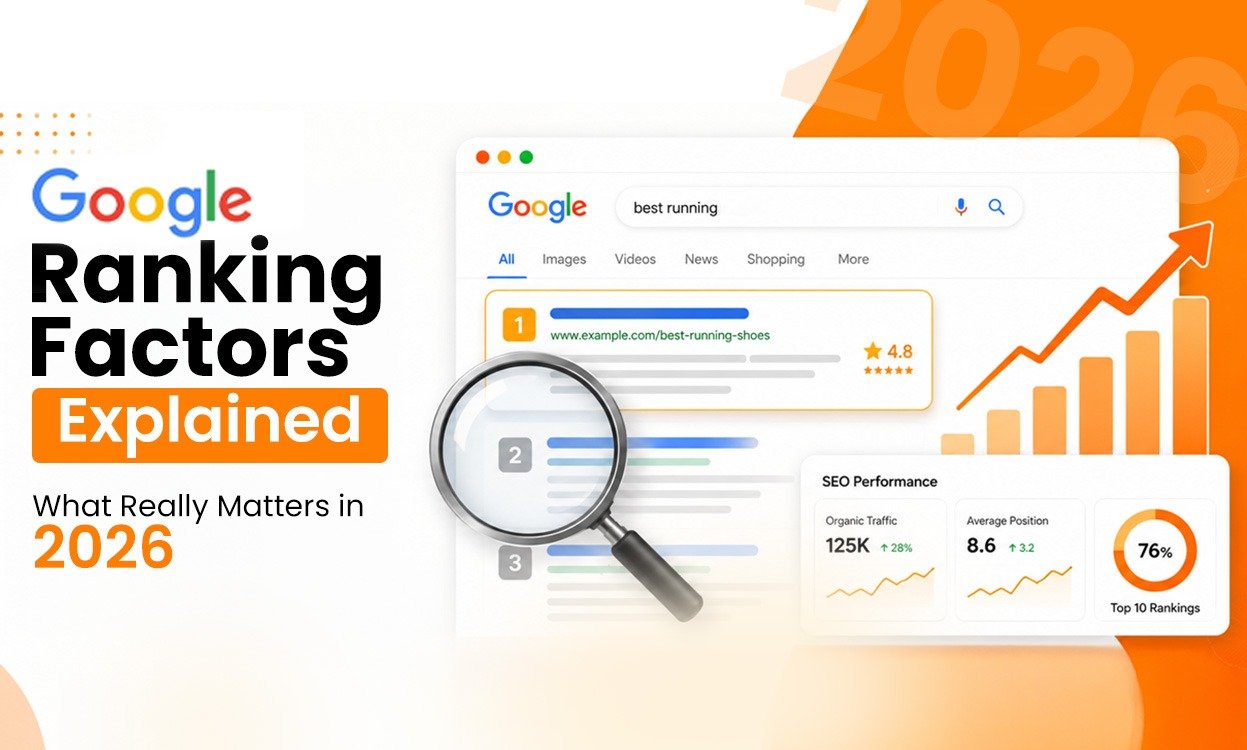
Search engines remain the primary way people discover information, products, and services online. Despite the rise of AI tools and social platforms, Google still handles the majority of global search traffic and continues to act as the main gateway to high-intent users.
In 2026, ranking higher on Google is no longer just about visibility—it directly impacts credibility, trust, and revenue. Businesses that appear on the first page consistently capture the majority of clicks, while lower-ranked pages often go unseen.
This guide breaks down how Google rankings work today and what actually moves the needle in modern SEO.
Book a free SEO audit with our team
Why Ranking on Google Still Matters
When users search on Google, they usually have clear intent—whether it’s to buy, compare, or learn something. That makes search traffic one of the highest-converting sources available.
Higher rankings lead to:
- Increased qualified traffic (users actively searching for solutions)
- Higher trust and brand authority
- Better conversion rates compared to social or paid impressions
- Long-term, compounding visibility without ongoing ad spend
Unlike paid ads, strong organic rankings continue to generate traffic even when you stop investing daily budget.
Book a free SEO audit with our team
How Google Rankings Work in 2026
Google’s ranking systems have evolved significantly. While traditional SEO factors still matter, Google now prioritises helpfulness, real-world experience, and content quality signals.
Today, rankings are influenced by:
- Content relevance to search intent
- Demonstrated experience and expertise (E-E-A-T)
- Page usability and engagement signals
- Site authority and backlink quality
- Technical performance and crawlability
Rather than simply matching keywords, Google evaluates whether your page fully satisfies the user’s query better than competing pages.
Core SEO Ranking Factors That Still Matter
Although algorithms have advanced, the foundations of SEO remain important.
- Content Quality and Depth
High-ranking pages provide clear, complete answers. Thin or repetitive content struggles to compete.
To improve:
- Cover topics in full depth
- Answer related user questions within the same page
- Use examples, data, and practical explanations
- On-Page SEO Structure
Well-structured content helps both users and search engines understand your page.
Focus on:
- Clear H1, H2, and H3 hierarchy
- Natural keyword usage (avoid stuffing)
- Optimised title tags and meta descriptions
- Internal linking between related pages
Book a free SEO audit with our team
- Mobile Experience and Page Speed
Google now evaluates pages primarily through mobile-first indexing.
Key improvements include:
- Fast-loading pages (especially on mobile networks)
- Responsive design across devices
- Minimal layout shifts during loading
- Backlinks and Authority Signals
Backlinks still act as trust signals—but quality matters far more than quantity.
Effective strategies include:
- Earning links from relevant, authoritative websites
- Digital PR and industry mentions
- Publishing original insights or data
Click here to know more about Content Quality and Depth.
On-Page SEO: Building a Strong Foundation
On-page SEO ensures your content is discoverable, readable, and aligned with user intent.
Best practices:
- Use keyword research tools (e.g., Google Search Console, Keyword Planner) to identify search demand
- Write clear, descriptive page titles aligned with intent
- Optimise meta descriptions for click-through rate, not just keywords
- Add internal links to related content for better site structure
- Use descriptive image alt text for accessibility and indexing
A well-structured page improves both rankings and user engagement, which are now tightly connected.
Off-Page SEO: Building Trust Beyond Your Website
Google evaluates how the wider web perceives your brand. Off-page SEO focuses on authority-building signals outside your website.
Key methods:
- Earn backlinks from reputable, relevant sources
- Maintain accurate business listings (especially for local SEO)
- Get brand mentions across industry publications
- Build visibility through thought leadership and guest content
For local businesses, optimising your Google Business Profile remains one of the most effective ways to increase visibility in map results and local searches.
Technical SEO: Ensuring Your Site Can Be Indexed Properly
Even great content won’t rank if search engines struggle to access or understand your site.
Important technical elements include:
- Fast page load performance
- Proper indexing and crawlability
- XML sitemaps and clean site architecture
- Structured data (Schema markup) for enhanced search results
- Secure HTTPS connections
Technical SEO ensures your website is not blocking its own ability to rank.
Creating Content That Ranks and Converts
Modern SEO is no longer just about traffic—it’s about outcomes.
High-performing content:
- Matches search intent precisely (informational, transactional, or navigational)
- Provides clear, actionable answers
- Uses examples, visuals, and structured formatting
- Builds trust through clarity and accuracy
Long-form content still performs well, but only when it is genuinely useful and well-organised.
A strong strategy is building pillar pages supported by related cluster content, which strengthens topical authority.
Book a free SEO audit with our team
Why Many Websites Fail to Rank
Even with good content, rankings can fail due to:
- Weak internal linking structure
- Poor mobile performance
- Lack of topical authority
- Low-quality or irrelevant backlinks
- Misaligned search intent targeting
In many cases, the issue is not content quality—but how the content is structured, supported, and distributed.
How to Improve Rankings in 2026
To improve visibility on Google today, focus on:
- Creating intent-driven, in-depth content
- Strengthening internal linking and site structure
- Improving page speed and mobile usability
- Building credible, relevant backlinks
- Updating and improving existing content regularly
SEO is now a continuous optimisation process, not a one-time setup.
Final Thoughts
Ranking higher on Google in 2026 is still one of the most powerful ways to grow consistent, high-intent traffic. However, success now depends on more than keywords—it requires a balance of content quality, technical performance, and real authority.
Websites that focus on genuine user value will continue to outperform those relying on outdated SEO tactics.
Frequently Asked Questions
1. How long does it take to rank higher on Google?
Typically 3–6 months, depending on competition, domain authority, and content quality.
2. Can I rank without backlinks?
Yes, for low-competition keywords—but backlinks are essential for competitive industries.
3. What is the most important SEO factor in 2026?
Search intent satisfaction and content quality are now the strongest ranking signals.
4. Do blog posts still help SEO?
Yes. Blog content builds topical authority and supports internal linking strategies.
5. Why is my website not ranking even with good content?
Common reasons include technical SEO issues, weak backlinks, or poor internal linking.