
Most businesses have a logo, a website and a social media presence. Far fewer have a brand strategy. The difference shows. Without one, every campaign starts from scratch, different people describe the business in different ways, and customers struggle to say why they should choose you over the next option.
A brand strategy framework fixes this by putting your decisions about who you serve, what you stand for and how you communicate into one working document. This guide shows you how to build one in practical steps, with examples, templates and measurement ideas you can adapt whether you run a small local business or lead a marketing team.
Book a 15-minute introductory call
Why a Brand Strategy Framework Matters
It makes you easier to choose. When your positioning is clear, prospects understand quickly what you do, who it’s for and why it’s different.
It keeps messages consistent. Consistency across website, social, email, proposals and phone calls builds familiarity, and familiarity builds trust.
It speeds up decisions. With clear guidelines, your team can approve a design, a headline or a campaign idea without lengthy debate.
It supports SEO and AI visibility. Search engines and AI tools reward clear, consistent signals about who you are and what you’re an authority on. Google’s guidance on helpful content stresses people-first content that demonstrates experience and expertise. A defined brand makes that easier to deliver across every page.
Brand Strategy vs Branding vs Brand Identity
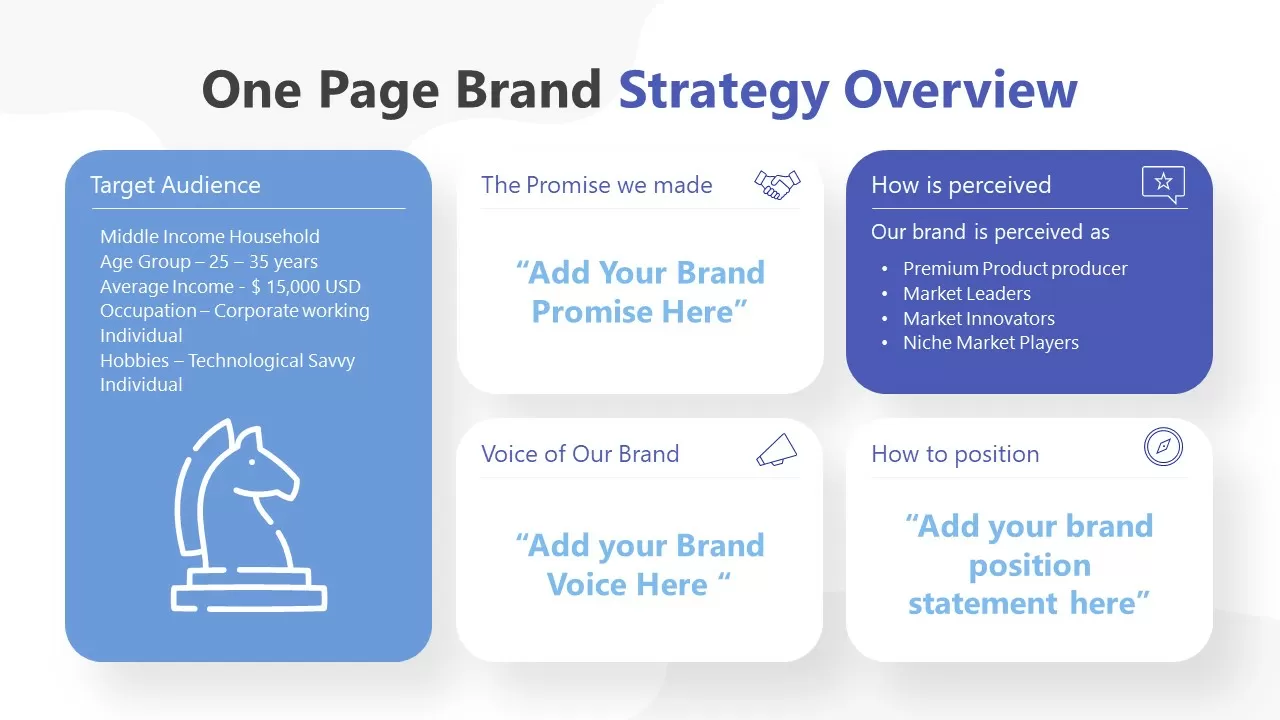
People often mix these up, so it helps to separate them.
| Term | What it means | Example |
|---|---|---|
| Brand strategy | The plan: who you serve, why you matter, how you’ll be perceived | “We help small trade businesses win local customers without jargon” |
| Branding | The ongoing activity of building and shaping perception | Campaigns, content, customer experience |
| Brand identity | The visible and audible elements | Logo, colours, fonts, tone of voice |
Strategy comes first. Identity and branding are how you express it. For general background, see Wikipedia’s overview of brand management.
Book a 15-minute introductory call
Step 1: Define Your Purpose, Vision and Values
Before you decide how to look or sound, decide why the business exists beyond making money.
- Purpose: the problem you exist to solve.
- Vision: where you want the business to be in several years.
- Values: three to five principles that guide behaviour, written as actions (“We explain things in plain English”) rather than buzzwords (“Excellence”).
Quick test: if a value could appear on any company’s website, it’s too generic. Make it specific enough that someone could disagree with it.
Step 2: Understand Your Customers Properly
Your brand lives in your customers’ minds, so start there. Run short conversations or surveys with recent customers and ask:
- What problem were you trying to solve when you found us?
- What almost stopped you from choosing us?
- How would you describe us to a friend?
- What frustrates you most about [the industry]?
Record their exact phrases. Those words often make better headlines than anything written in a meeting room. Combine interviews with behaviour data from your website and social analytics, using Google Analytics and Google Search Console to see what people actually search for and click.
Build two or three simple customer profiles. For each, note goals, frustrations, where they look for information and what would make them trust you.
Step 3: Study Competitors and Find Your Gap
List your five closest competitors and review their websites, messaging, pricing signals and reviews. Then map them on a simple grid, for example premium vs affordable on one axis and specialist vs generalist on the other. The empty or under-served space is where positioning opportunities usually sit.
Ask: what does everyone in our market say, and what is nobody saying?
Step 4: Write Your Positioning Statement
Positioning is the specific place you want to occupy in your customer’s mind. Use this template and keep it internal:
For [target customer] who [need or problem], [Brand] is the [category] that [key benefit], because [reason to believe].
Example: For Australian trades businesses who struggle to get found online, [Brand] is the digital marketing partner that turns local searches into booked jobs, because we focus only on service businesses and report on enquiries, not vanity metrics.
A strong positioning statement has three qualities: it’s specific, it’s true, and it’s something competitors can’t easily claim. Positioning that pairs a rational benefit with an emotional one (confidence, relief, pride) tends to be more memorable. Customers remember how you made them feel as well as what you delivered.
Book a 15-minute introductory call
Step 5: Develop Your Brand Voice and Messaging
Voice is your brand’s personality in words. Define it in three parts.
- Voice attributes. Pick three or four traits and pair each with a “but not”: Friendly, but not casual to the point of unprofessional. Expert, but not jargon-heavy. Direct, but not blunt.
- Core messages. Write one main message and three supporting points that every channel can draw from.
- Do and don’t examples. Show real sentences. For instance:
| Do say | Don’t say |
|---|---|
| “We’ll explain every line of your quote.” | “We leverage synergies to optimise outcomes.” |
Add a short list of words you use and words you avoid. This is the quickest way to keep many writers sounding like one brand.
Step 6: Create a Consistent Visual Identity
Turn your positioning into visual guidelines that cover:
- Logo: versions, minimum sizes, clear space and misuse examples
- Colour palette: primary, secondary and accessible text colours with exact codes
- Typography: headline and body fonts, sizes and spacing
- Imagery: photo style, illustration style, icon set
- Layouts: examples for social posts, emails, presentations and web pages
Check colour contrast for accessibility using the W3C Web Accessibility Initiative guidance on contrast. Accessible design reaches more people and reflects well on your brand.
If you use website images as part of your identity, follow image best practices from our guide on optimising website images for SEO.
Step 7: Craft a Tagline and Brand Story
A tagline compresses your positioning into a few memorable words. Good ones tend to share five traits:
- Rooted in identity: linked to your purpose and values
- Short and clear: easy to say and remember, with no jargon
- In character: bold if you’re bold, warm if you’re warm
- Tested: shown to a small group of customers, with a quick online poll or ad test as a check
- Governed: with clear guidance on where and how to use it
Nike’s “Just Do It” is a well-known example of a tagline that expresses a brand attitude rather than describing a product.
Your brand story is the short narrative behind the business: why it started, the problem you saw and what you do differently. Keep it honest and specific. A founder’s real origin story is more credible than a polished invention, which supports the “experience” and “trust” signals Google’s quality guidelines describe as part of E-E-A-T.
Step 8: Align Your Marketing Channels With the Brand
Once the foundations are set, make every channel carry the same story in a format suited to the platform.
| Channel | Role in the brand | Practical tip |
|---|---|---|
| Website | Home base for your story and proof | Keep messaging and visuals consistent across every page |
| SEO | Show up when people search for answers | Build content around real customer questions; see our keyword research guide |
| Paid ads (PPC) | Drive targeted visibility and enquiries | Use the same message and visuals as organic content |
| Social media | Start conversations and show personality | Pick two or three platforms, not all of them |
| Nurture relationships | Segment by customer type and stage | |
| Content marketing | Demonstrate expertise | Publish guides, case studies, short videos and infographics |
Use buyer profiles to segment and tailor messages. A first-time visitor and a returning customer need different things from the same brand.
Google’s Business Profile help is also worth reviewing if you serve local customers. Consistent business name, address, categories and imagery support both brand and local visibility.
Book a 15-minute introductory call
Step 9: Turn Your Team Into Brand Advocates
Employees shape perception every day through emails, calls, meetings and social posts. Customers often trust people more than logos, so employee voices can carry real weight.
How to build advocacy without forcing it:
- Onboard everyone on the brand. Share the strategy, the reasons behind it and the voice guide, not just a PDF.
- Make sharing easy. Provide a simple content kit: key messages, images, suggested posts and posting tips.
- Let people use their own words. Authentic posts beat copy-pasted ones.
- Train briefly on best practice. Cover disclosure, confidentiality and what not to share.
- Recognise contributions. Celebrate people who share, refer or help create content. Recognition works better than pressure.
- Keep it optional. Advocacy only works when it’s voluntary.
If you’re short on internal capacity, an agency can build the training materials, content kit and publishing plan, leaving your people free to share real stories.
Step 10: Measure, Learn and Refine
A brand strategy isn’t a one-off document. Set a small number of KPIs tied to your goals and review them on a schedule.
| Goal | Example metrics | Where to look |
|---|---|---|
| Awareness | Branded search volume, direct traffic, reach | Search Console, Analytics, social insights |
| Engagement | Time on page, email click rate, social engagement | Analytics, email platform |
| Lead quality | Enquiry-to-customer rate, lead source quality | CRM, Analytics |
| Perception | Survey responses, review themes, Net Promoter Score | Surveys, review sites |
| Consistency | Brand audit scores across channels | Internal checklist |
Review quarterly. Adjust positioning or tone if your audience shifts, refresh the guidelines after major changes, and test new channels in small pilots before committing budget.
Quick Brand Strategy Checklist
Use this before you launch or relaunch:
- Purpose, vision and values written down
- Two or three customer profiles based on real conversations
- Competitor comparison completed
- Positioning statement approved by leadership
- Voice guide with do and don’t examples
- Visual identity guide with accessible colours
- Tagline tested
- Channel plan aligned to the core message
- Team onboarding and content kit ready
- KPIs and review dates set
Common Brand Strategy Mistakes
- Writing it once and filing it away. If the team doesn’t use it, it isn’t a strategy.
- Trying to appeal to everyone. Broad positioning is forgettable.
- Starting with the logo. Visuals should express a strategy, not replace one.
- Using vague values that could belong to any business.
- Ignoring customer language and relying on internal assumptions.
- Inconsistent execution, with different tones and visuals across channels.
- Skipping measurement, so nobody knows what’s working.
Book a 15-minute introductory call
How to Build Trust and Credibility Into Your Brand
Trust is the outcome every part of the framework is working toward. You can strengthen it by:
- Showing real experience. Share case studies, project photos and results with client permission. [Insert a verified DigiTotal example here, such as “When we helped [client type] clarify their positioning, enquiries from [source] increased by X% in Y months.”]
- Naming real people. Author bios, team pages and founder stories make a brand feel human.
- Being transparent. Clear pricing guidance, honest limitations and visible contact details matter.
- Collecting and responding to reviews. Social proof is one of the most persuasive trust signals.
- Citing credible sources. Back claims with reliable data and keep content updated.
Frequently Asked Questions
What is a brand strategy framework?
It’s a structured plan that defines your brand’s purpose, audience, positioning, voice, visual identity and marketing approach, so everyone in the business communicates consistently.
What are the key components of a brand strategy?
The main components are purpose and values, target audience, positioning, brand voice and messaging, visual identity, tagline and story, channel alignment, team advocacy, and measurement.
How do I create a brand strategy step by step?
Define your purpose and values, research customers and competitors, write a positioning statement, develop voice and messaging, design your visual identity, align marketing channels, engage your team, and track results against clear KPIs.
What is the difference between brand strategy and marketing strategy?
Brand strategy defines who you are and how you want to be perceived. Marketing strategy covers the campaigns and channels that promote the business. Brand strategy should guide marketing, not the other way around.
How long does it take to build a brand strategy?
A focused project for a small business can take a few weeks, including research, workshops and documentation. Larger organisations may need a few months. Rolling it out across the team and channels is ongoing.
How much does a brand strategy cost?
It varies widely with scope, from a simple internal exercise to a full agency project with research and identity design. Ask for a clear scope and deliverables before you commit. [Add your own pricing guidance if you publish it.]
How do I write a good brand positioning statement?
Name your target customer, their problem, your category, your main benefit and your reason to believe it. Keep it specific and make sure it’s something competitors can’t easily claim.
How do employees help build a brand?
Employees represent the brand in every interaction. When they understand and believe in it, their conversations, social posts and service quality make the brand more credible and trustworthy.
How often should I review my brand strategy?
Review KPIs quarterly and do a deeper strategy review annually, or sooner if your audience, offering or market changes significantly.
Does brand strategy affect SEO?
Indirectly, yes. A clear brand helps you create consistent, helpful content, earn mentions and increase branded searches, all of which support visibility in search and AI-generated answers.
Conclusion: Key Takeaways
A strong brand strategy framework turns scattered marketing activity into a consistent, recognisable presence. Start with purpose and customer insight, define a specific positioning, give your brand a clear voice and visual identity, align your channels, involve your team, and keep measuring and refining.
Ready to build a brand your customers remember? Book a free 15-minute introductory call with DigiTotal and we’ll help you identify your clearest brand opportunities