
If you’re launching a business or trying to grow an existing one, you will hit this question sooner or later: do I invest in SEO or PPC?
SEO (search engine optimisation) earns free, long-term visibility in Google’s organic results, but takes months to build. PPC (pay-per-click advertising) buys immediate visibility, but stops the moment your budget does. Most businesses do best by choosing one as the lead channel based on their cash flow and timeline, then layering in the other.
This guide explains how each channel works, what each really costs, and where each tends to fail. It also gives you a simple framework for deciding, and covers how AI-generated answers in Google are changing the picture.
Book a 15-minute introductory call
What Is SEO?
Search engine optimisation is the practice of improving your website so Google can find it, understand it and show it for relevant searches, without paying for each visit.
When someone searches “emergency plumber Brisbane”, Google returns a results page that mixes ads, a map pack and organic listings. SEO is how you earn a place in the map pack and the organic results.
SEO has three main parts:
- Technical SEO: site speed, mobile usability, crawlability, secure hosting and clean site structure. Google’s Core Web Vitals are the standard measure of page experience.
- Content SEO: pages and articles that answer what your customers are actually searching for, built around well-researched keywords.
- Authority building: earning mentions and links from credible sites, plus reviews and a well-maintained Google Business Profile for local businesses.
Google’s own SEO Starter Guide is a good, official reference for the fundamentals. For a neutral overview, see Wikipedia’s entry on search engine optimization.
What Is PPC?
Pay-per-click advertising means you bid to have your ad shown to people searching certain terms, or browsing certain platforms, and you pay only when someone clicks.
The most common platforms are:
- Google Ads: search, Shopping, YouTube, Display and Performance Max campaigns.
- Meta Ads (Facebook and Instagram): strong for demographic and interest targeting. See Meta’s advertising overview.
- LinkedIn and others: useful for B2B and niche audiences.
Google doesn’t simply hand the top spot to the highest bidder. Its ad auction weighs your bid alongside ad relevance, expected click-through rate and landing page experience, summarised in Quality Score. That’s why a well-built campaign can beat a competitor with a bigger budget.
For background, see Wikipedia on pay-per-click.
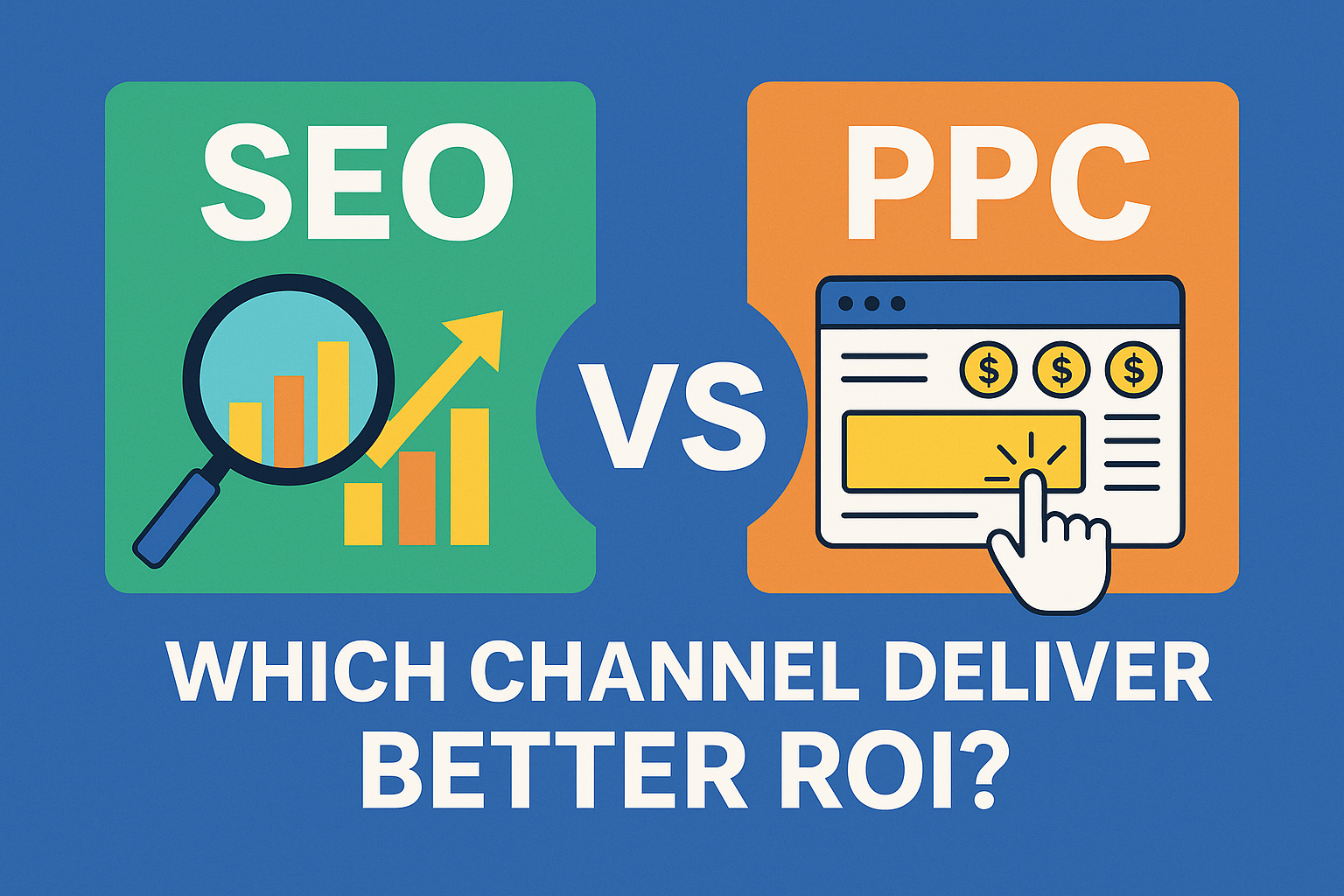
SEO vs PPC: Side-by-Side Comparison
| Factor | SEO | PPC |
|---|---|---|
| Time to first results | Typically 3–6+ months | Hours to days |
| Cost structure | Upfront effort, then lower ongoing cost | Pay for every click, indefinitely |
| Traffic after you stop | Continues, with gradual decline | Stops immediately |
| Visibility position | Organic listings, map pack, AI answers | Top and bottom of results, plus other platforms |
| Targeting | Based on search intent and content | Keyword, location, device, audience, schedule |
| Scalability | Gradual, compounding | Fast, but costs scale with it |
| Best for | Authority, steady lead flow, lower long-term cost | Launches, promotions, testing, urgency |
| Main risk | Slow start, algorithm changes | Rising click costs, wasted spend |
The Real Advantages and Drawbacks of SEO
Where SEO wins
It compounds. A well-written service page or guide can bring in enquiries for years. Unlike an ad, it doesn’t switch off when you stop paying.
It reaches people at every stage. Someone reading “how much does a retaining wall cost?” is researching. Someone searching “retaining wall builder near me” is ready to call. A good SEO plan covers both, through guides, service pages, case studies and FAQs.
It builds credibility. Appearing consistently in organic results tells searchers you’re an established player. Content that shows genuine expertise also earns links, which strengthens rankings further.
It’s easier to forecast over time. Once a site has momentum, traffic tends to move gradually rather than vanish overnight, which makes planning easier.
Where SEO struggles
It’s slow. If you need leads next week, SEO alone won’t deliver them. Newer websites in competitive industries often need six to twelve months of consistent work.
It never really ends. Competitors publish, Google updates its systems and your content ages. Ongoing maintenance is part of the deal.
It’s competitive. A new online home-decor store can’t expect to outrank national retailers for broad terms like “outdoor furniture”. The winning move is targeting specific niches and local intent first.
It takes varied skills. Technical fixes, content strategy, writing and link earning are different skill sets. That is why many businesses outsource SEO.
Book a 15-minute introductory call
The Real Advantages and Drawbacks of PPC
Where PPC wins
Speed. A properly set up campaign can generate enquiries on the first day. That makes it valuable for new launches, seasonal peaks and time-limited offers.
Control. You choose the message, the landing page, the location, the schedule and the daily budget. A Brisbane electrician can show ads only within a set radius, only during business hours.
Rapid testing. Run two ad versions or two landing pages and you’ll quickly see which wins. This learning is valuable beyond paid search, because the headlines and offers that convert in ads often inform your SEO content too.
Clear measurement. With conversion tracking set up, you can see exactly which keywords produced calls and sales.
Where PPC struggles
You rent your traffic. Pause the budget and the leads stop.
Click costs vary enormously. Some keywords cost very little. Competitive sectors such as legal, finance, insurance and home services can be expensive, and costs rise when more advertisers bid on the same terms.
It punishes weak setups. Poor keyword targeting, a slow landing page or missing negative keywords can burn through budget without producing customers.
Competitors can see your ads. Rivals can monitor your messaging and bid against you, which can push up costs.
Ad fatigue is real. Audiences tune out ads they’ve seen repeatedly, so creative needs regular refreshing.
How Much Do SEO and PPC Really Cost?
Costs vary widely by industry, location and competition, so treat any single figure with caution. What matters is understanding the structure:
- PPC cost = ad spend + management + tools. Your ad budget is only part of it. Factor in campaign management, landing page improvements and conversion tracking.
- SEO cost = time and expertise. There’s no per-click fee, but you pay for strategy, content creation, technical work and ongoing optimisation, whether in-house or through an agency.
A useful way to compare them is cost per lead, not cost per click. If PPC delivers a lead at a predictable price, you can calculate exactly how much you can afford to spend. If SEO takes six months to ramp up, calculate the total investment over twelve to eighteen months and divide by the leads it generates over that period. SEO usually looks more expensive early and cheaper later.
Google’s published economic impact research has suggested advertisers earn roughly two dollars in revenue for each dollar spent on Google Ads. Treat that as a general benchmark rather than a promise: your result depends on your margins, offer and conversion rate.
How to Decide: A Simple Framework
Ask yourself these five questions.
- How soon do you need leads?
Within weeks → start with PPC. Over months → SEO is viable. - What’s your cash flow like?
Limited and needing quick return → a tightly controlled PPC budget. Able to invest for compounding returns → SEO. - How competitive are your keywords?
Highly competitive → test with PPC first to confirm the keywords convert before investing in SEO. Low or moderate competition → SEO may deliver faster than you expect. - Is your business local or national?
Local service businesses benefit enormously from local SEO (Google Business Profile, reviews, location pages) alongside geo-targeted ads. - Is your offer time-sensitive?
Sales, events and seasonal services suit PPC. Evergreen services suit SEO.
Quick recommendations by business type
- Brand-new business: PPC for immediate visibility while building SEO foundations.
- Local trades and services: local SEO as the base, with PPC for peak seasons.
- Ecommerce store: PPC (including Shopping ads) for sales, SEO for category and product content.
- B2B or high-consideration services: SEO content to build trust, PPC and LinkedIn for targeted outreach.
- Established brand with steady demand: SEO to protect and grow organic share, PPC for new products and promotions.
Book a 15-minute introductory call
Using SEO and PPC Together
Treating the two channels as rivals leaves value on the table. Here is how they strengthen each other.
Use PPC to bridge the SEO waiting period. While your organic rankings build, paid ads keep leads flowing.
Use PPC data to choose SEO targets. Search term reports show which keywords really convert, which removes guesswork when you plan content.
Test headlines in ads, then use them on your pages. Messaging that earns clicks and conversions is a strong candidate for page titles and calls to action.
Retarget organic visitors. Most visitors leave without enquiring. Remarketing ads bring them back to book, call or buy.
Dominate the results page. When your business appears in both an ad and an organic listing, you occupy more of the screen and reinforce trust.
Optimise landing pages with SEO principles. Fast, clear, mobile-friendly pages improve both organic rankings and ad performance, because landing page experience feeds Quality Score.
Share budget flexibly. A landscaping company might increase PPC spend ahead of spring and pull back in quieter months, while SEO continues working year-round.
How AI Overviews Are Changing SEO and PPC
Google now shows AI-generated summaries, called AI Overviews, for many searches. This affects both channels.
For SEO: Google states that the same fundamentals apply to its AI features: helpful, people-first content that’s technically accessible and well structured. Its guidance on AI features and your website is worth reading. To improve your chances of being cited in AI answers:
- Answer questions directly and clearly near the top of the page.
- Use descriptive headings that mirror real questions.
- Show real expertise: named authors, credentials, first-hand experience and original examples.
- Add structured data (see the schema below) so machines can interpret your content accurately.
- Keep your business details consistent across your website, Google Business Profile and directories.
For PPC: Google has been expanding ads placement within and around AI-generated results. Strong, relevant ad copy and well-matched landing pages remain essential. Features such as broad match and Performance Max lean heavily on your conversion data, so accurate tracking is more important than ever.
The practical takeaway: Searchers increasingly get quick answers without clicking. Content that is genuinely useful, trustworthy and specific stays visible, and paid campaigns need sharper targeting to justify each click.
Book a 15-minute introductory call
Why Trust Matters: E-E-A-T in Practice
Google’s guidance on helpful content emphasises experience, expertise, authoritativeness and trustworthiness (E-E-A-T). In practice, that means:
- Experience: Share real campaign results and lessons, not generic advice.
- Expertise: Have qualified people write or review your content, with visible bios.
- Authoritativeness: Earn citations and links from respected sites in your industry.
- Trustworthiness: Display clear contact details, honest claims, reviews and transparent pricing.
On the advertising side, Australian businesses must also make sure ad claims are accurate. The ACCC’s advertising and promotions guidance explains your obligations under Australian Consumer Law. For general small business marketing resources, see business.gov.au.
Common Mistakes to Avoid
With SEO:
- Targeting keywords that are too broad to win.
- Publishing thin or duplicated content.
- Ignoring mobile speed and usability.
- Expecting results in weeks, then abandoning the work too early.
With PPC:
- Sending all clicks to the homepage instead of a focused landing page.
- Skipping negative keywords, which wastes spend on irrelevant searches.
- Launching without conversion tracking.
- Setting and forgetting. Campaigns need regular review.
With both:
- Measuring clicks or rankings instead of leads and revenue.
- Running them in separate silos with no shared data.
Key Statistics to Know
These numbers help frame the decision. Always check the source for the latest figures, as they change.
- Search share in Australia: Google handles the large majority of searches, according to StatCounter’s Australian data, which is why most Australian search marketing centres on Google.
- Google Ads returns: Google’s economic impact research has suggested roughly $2 in revenue for every $1 spent on ads, on average.
- Long-tail searches: A very large share of searches are longer, specific phrases, which is where smaller businesses can compete in SEO.
Editor’s note: Before publishing, verify each statistic against its source and add a “last updated” date to the page.
Frequently Asked Questions
Is SEO or PPC better for a new business?
Neither is universally better. PPC gives immediate visibility, which helps new businesses start generating leads and learning what works. SEO builds long-term, low-cost traffic. Most new businesses benefit from starting with a focused PPC campaign while laying SEO foundations.
How long does SEO take to work compared with PPC?
PPC can produce clicks within hours of launch. SEO typically takes three to six months to show meaningful movement, and longer in competitive industries.
Is SEO cheaper than PPC?
Over the long run, usually yes, because organic clicks carry no per-click fee. In the short term SEO can cost more upfront because you’re investing in strategy and content before results appear.
Can I do SEO and PPC at the same time?
Yes, and it’s often the strongest approach. PPC delivers fast traffic and keyword data, while SEO builds sustainable visibility and lowers your reliance on paid clicks.
Do ads hurt my organic rankings?
No. Running Google Ads doesn’t directly affect your organic rankings. However, the data and landing page improvements from PPC can indirectly help your SEO.
Do AI Overviews make SEO or PPC less effective?
They change user behaviour, but they don’t make either channel obsolete. Clear, expert, well-structured content can be cited in AI answers, and well-targeted ads still capture high-intent searchers.
How much should a small business spend on PPC?
There’s no universal figure. Start with a budget you can afford to test for at least a few weeks, work out your target cost per lead, and scale only once conversion tracking shows the campaign is profitable.
How do I know if my SEO or PPC is working?
Track leads and revenue, not just traffic. Use Google Analytics and conversion tracking to monitor calls, form submissions and sales, and compare cost per lead across both channels.
Should I hire an agency or do it in-house?
If you have the time and are willing to learn, you can start in-house. Agencies bring tools, experience and efficiency, which often prevents costly mistakes, especially with PPC budgets.
H2: Conclusion: Choose by Goal, Then Combine
SEO and PPC solve different problems. PPC buys speed and control. SEO builds trust and long-term value. The best choice depends on how quickly you need leads, how much you can invest and how competitive your market is.
To summarise:
- Choose PPC first if you need results now, are launching an offer or want to test demand.
- Choose SEO first if you’re building for the long term and can wait for compounding returns.
- Choose both if you can, because they generate data and visibility that strengthen each other.
- Whichever you choose, track leads and revenue, not vanity metrics.
Not sure where to start?
Book a free 15-minute introductory call with DigiTotal. We’ll review your goals, budget and market, and tell you honestly whether SEO, PPC or a blend is right for you.
Call 0416 968 210 or Book your call.
DigiTotal has over 20 years of experience helping Australian businesses grow through SEO, PPC and digital marketing.